Tuthill family’s Orient subdivision plans met with mixed reactions

A 112-acre, 80/60 conservation subdivision of land in Orient owned by the Tuthill family encountered mixed reactions from community members, both in favor and opposed, at an April 7 Southold Planning Board public hearing.
More than 60 residents attended to hear and share public comments about the proposal.
The Tuthill Oysterponds Holding Company was established in December 2006 to consolidate management and control of certain properties owned by the family, whose roots in the area date back to the 1600s. The company consists of 10 family members — of whom four are managing members and six are limited members, according to a December 2024 overview of the proposed conservation subdivision.
Managing member Carol Tuthill gave background on the family’s history in Orient at the hearing and explained why they feel their “proposal is aligned with the goals of the Orient community.”
She called on the memory of her father-in-law, John Brown Tuthill, who was born and raised in Orient, where he was an active member of the community.
“He frequently reminded his family members and their spouses that he was counting on them to continue his legacy by doing three things,” Ms. Tuthill said. Those included: keeping the land in the family for future generations to live or vacation, continuing service as good stewards of agriculture and aquaculture and taking an active role in programs that affect and benefit the Orient community at large.
She said the choice to pursue a conservation subdivision “minimized the impact on existing agriculture and aquaculture operations” and the environment.
“This is good for us and the community,” Ms. Tuthill said. “And it has a significant impact on the preservation of Orient.”
The proposed plans
The subdivision would turn four parcels totaling 112 acres — owned by the family holding company — into 17 residential lots, with 94 acres to be preserved. The plans have been in the works since 2011, per Planning Board documents. None of the residential lots would be designated for affordable housing.
Planning Board chairman James Rich III said the subdivision has been through a “detailed review since 2014” that included many studies, such as cultural resource field studies and watershed impact studies.
“As a result of the review of the watershed, the lots have been located to best preserve viewsheds from and for the public viewpoints,” he noted.
The acreage encompasses four plots of land in Orient: the North Dyer parcel at 21505 Main Road; the South Dyer parcel on Rackett’s Court; the North Brown parcel on Main Road near Narrow River Road; and the South Brown parcel on Narrow River Road.
Of those parcels, North Dyer is the only one that is not currently farmed. The holding company’s December 2024 overview document stated that North Dyer could be farmed in the future if a viable project is defined that meets all requirements.
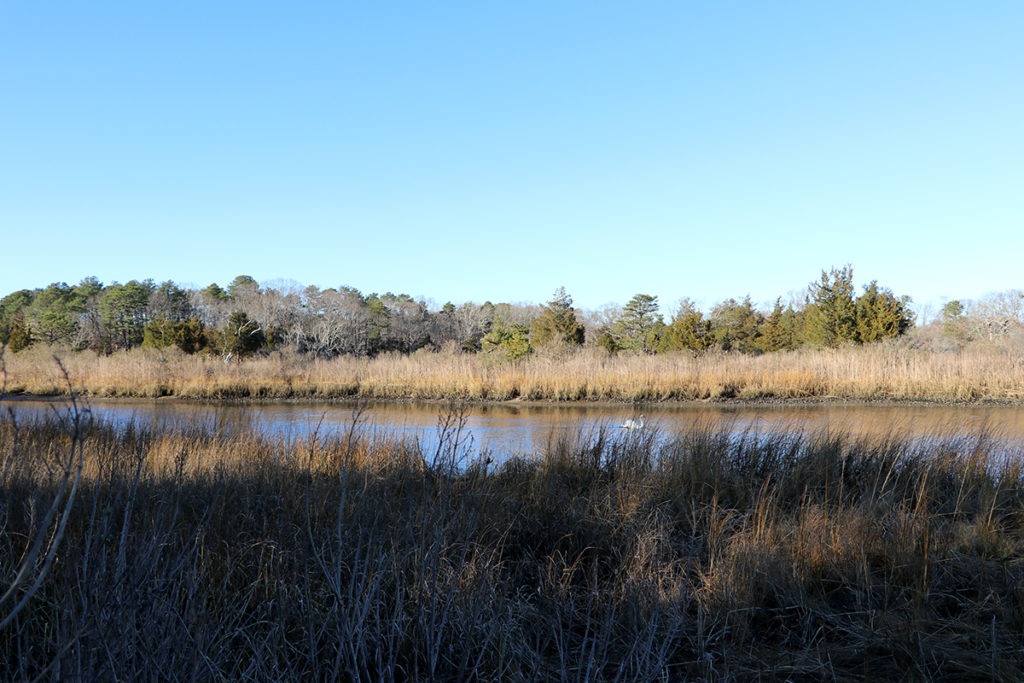
Development at the South Dyer parcel will prohibit public access to the creek but will allow new construction for agriculture or aquaculture businesses and the ability to improve the land to meet state and federal requirements for such businesses. The current business on the parcel, Latham Farm Stand, will be maintained in working condition.
On the North Brown parcel, the company would be able to construct and maintain structures that allow for beach access to Long Island Sound but public access to those buildings would be prohibited.
All parcels would allow family recreation such as weddings, town fundraisers, charitable events and reunions, as well as family nonprofit and for-profit business operations. They would also allow for storage of large items such as boats, classic cars, RV storage and farm equipment.
In addition, South Dyer, North Brown and South Brown would allow access for hunting in compliance with Southold Town regulations on the properties.
In a Feb. 25 planning department staff report, the applicant proposed a Homeowners Association for the residential developments. All 10 members of the company will become members of the HOA and owners of the lots established in the subdivision. Management of the HOA “will be a natural extension to the work the company has done since 2006 to preserve and maintain the four parcels,” the December 2024 overview stated.
Public comments
Sixteen residents spoke during the April 7 public hearing, with comments split in their support or opposition to the subdivision.
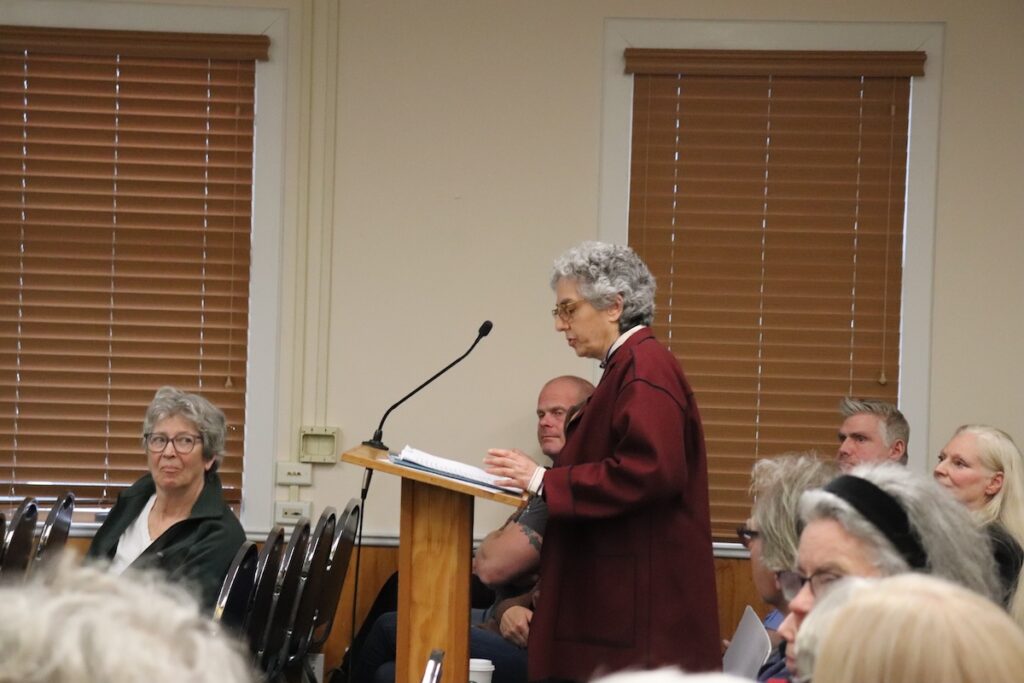
Residents of Rackett’s Court, a proposed access route to the South Dyer plot, have for years expressed concerns about the use of their road outlined in the plans. Barbara Cohen, a town resident and longtime real estate planning consultant, expressed opposition to the plan on behalf of Rackett’s Court residents.
“To be clear, we are not the enemy of the applicant nor of the preexisting farmland or shellfish businesses, nor of the Planning Board,” she said. “We simply want the design for the South Dyer section to reflect good planning, to be consistent with the [Southold Town] Comprehensive Plan, provide clear definitions and incorporate the thoughtful ongoing input from those most impacted.”
Ms. Cohen proposed that large-scale events and storage for equipment unrelated to farming uses mentioned in the plans should be restricted or removed altogether. She also called for increased clarity and guidance about new construction and business operations on the property in the plans.
Suzanne Horton, who lives across the street from the South Dyer lot and is related to the Tuthills, echoed Ms. Cohen’s concerns. She expressed apprehension about noise, traffic, visual, economic and environmental impacts that the development might cause.
Orient resident Erin Stanton, a co-owner of Latham Farms, which sits on land owned by the Tuthills that is intended for preservation, said her family-run business would continue to operate on its 25-acre parcel.
“In the 40 years that I’ve lived in Orient, I have watched the amount of farmland significantly decrease,” she said, citing the loss of Latham Point Farm, Terry Farm and Douglass Farm as a few examples.
“What the Tuthills are trying to do is preserve land so that we can keep farming,” she continued. “My point is, farmland in Orient is becoming very scarce. Our family sees the Tuthill Conservation Subdivision as an opportunity to preserve the farmland that they own so that we can continue with the way of life that for us, and for many, defines the culture of Orient.”
Walter Strohmeyer of Orient commended the Tuthills for their stewardship efforts in the community.
“They have done a very good job of preserving what they have and making things good so that progress is not stopped, but slowed up,” he said. “And I think they have it very much in the interest of themselves as residents of Orient.”
The Planning Board will accept written comment about the conservation subdivision through Wednesday, May 7.