Greenport survey says more mixed-use development

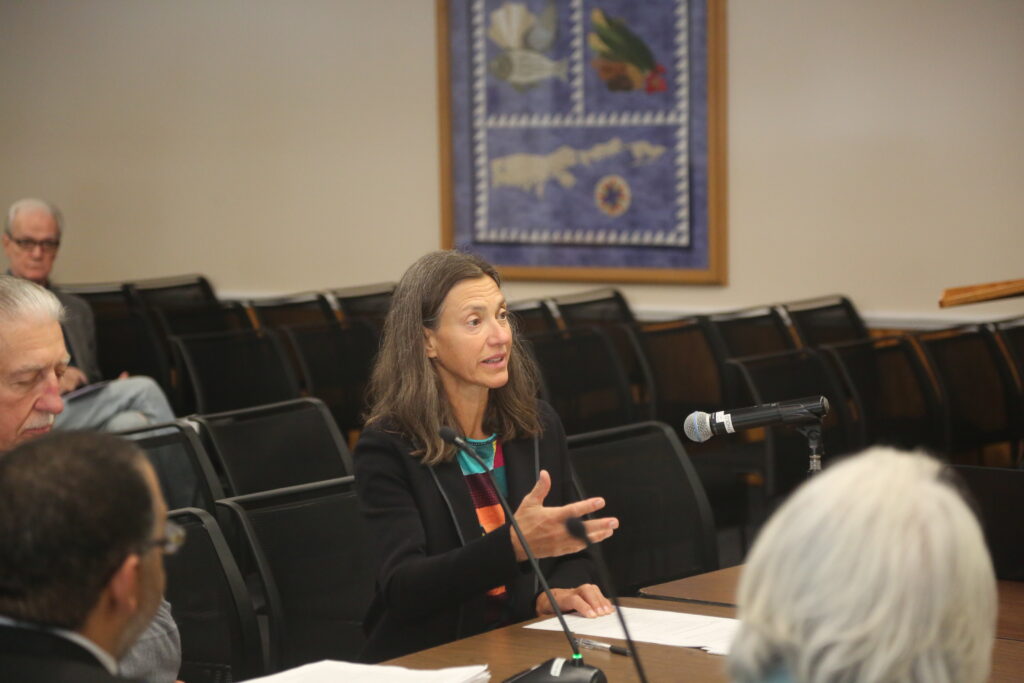
The Village of Greenport Planning Board presented the results of a survey it conducted throughout June to gauge the community on issues related to commercial and residential vibrancy at its July 28 work session.
The village surveyed from June 10 to 30, sending out postcards and flyers and allowing for completion online or in print. By the end of the surveying period, 177 were completed and submitted.
“First off, I want to thank board members Elizabeth Talerman and Frances Walton in particular for all of their hard work on the survey. I also want to thank all the members of the public that participated in the survey,” said chairwoman Patricia Hammes. “This wouldn’t be valuable without your input. The survey was designed to gather a clear and more data-driven understanding of how Greenport residents feel about some of the recurring and divisive topics that come up in discussions about the village.
“Rather than relying on hearsay or on the loudest voices in the room, we hope that the survey would give us and the Board of Trustees the opportunity to get some real insight into the community’s priorities and concerns.”
Topics included affordable housing, mixed-use zoning in the downtown commercial district, accessory dwelling units, administrative approval of new construction, commercial and residential property vacancies, and parking in the downtown commercial district. All interested parties were able to complete it, with responses being separated into resident, commercial property owner and business owner/employee categories. A majority of responses came from homeowners and full-time residents.
Nearly all of the topics were also brought up at the July 24 board of trustees meeting, when residents and business owners expressed their concerns with each aforementioned topic. Surveyors ranked affordable housing, property vacancy, mixed-use zoning and ADUs as the most important issues, in that order, with parking in the downtown commercial district coming in after.
Mixed-use development
Most responses were in favor of mixed-use development, to allow second and third-floor residences above a first-floor commercial space. Just under 84 percent supported second-floor constructions, and just over 57 percent supported third-floor constructions.
Feedback from the community regarding the development centered on affordability, parking considerations, the need to maintain community and architectural character, and the suggestion that it should be limited to full-time residential use, with third-floor construction restricted to avoid excessive massing.
Accessory dwelling units
The responses showed an overwhelmingly strong support for ADUs, albeit with some requirements and preferences.
Some of the feedback showed community members preferred that there be no more than two units on a property, that either the main building or the ADU is occupied by the owner, and that the property has no short-term rentals.
Vacant properties
There was also overwhelming support for requiring a vacant property registry. The registry would include houses and properties not used, not maintained or abandoned, and if they are closed, unoccupied and/or closed for more than a year. Some responses also questioned the purpose of a registry in general.
Administrative approval of new construction
Just under 62 percent of residents and 80 percent of commercial property owners were in favor of an administrative approval process for new residential construction or a project that substantially replaces an existing home. Said projects would not include minor changes like additions, renovations or remodels that don’t impact the existing structure.
Parking
Surveyors showed robust support for a residential parking sticker program for all residents. Just over 72 percent of residents were in favor, and just over 63 percent of commercial property owners were in favor.
Metered parking was a different story, though. Residents were in favor of metered parking on Main and Front Streets, but others were mostly opposed. Surveyors were mostly opposed to metered parking in the Adams and South Street lots. Community responses regarding meters centered around enforcement, possible exceptions for residents, first responders, people with disabilities and employees. Some also wanted the meters to have time limits.
When it came to parking requirements, community members shared that they believe hotels should be required to provide on-site parking spaces more than other locations.