North Fork farmers adapt crops, schedules to climate change impacts
The conversation around climate change often feels abstract, but for North Fork farmers, its effects are measured in tangible terms: delayed harvests, frost-damaged crops, and the constant recalibration of growing strategies that have guided their families for generations.
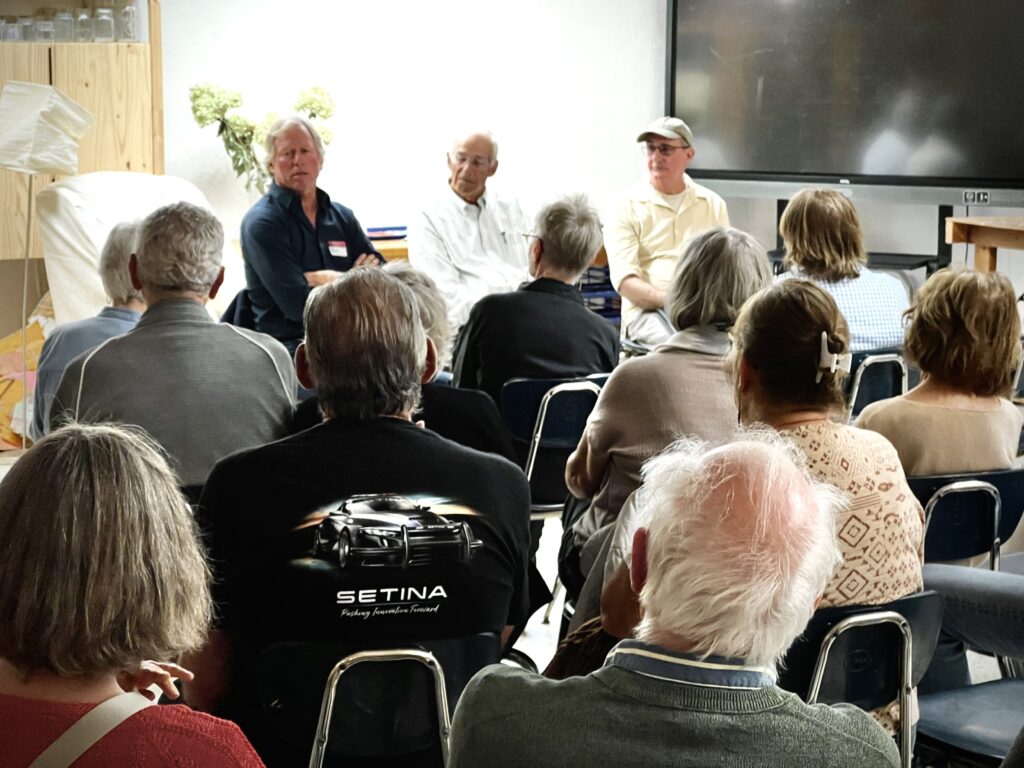
Three of the area’s most experienced agricultural leaders gathered Thursday, Sept. 25, at the Cutchogue Civic Association to discuss how increasingly unpredictable weather is reshaping their operations. What emerged was a candid portrait of an industry in transition, where traditional farming wisdom meets the reality of a changing environment.
For Ron Goerler of Jamesport Vineyards, climate shifts have brought an unexpected benefit. His vineyard now enjoys an extended growing season that stretches well beyond traditional harvest times.
“We typically picked in September, but now we’re harvesting in October and into November if the weather cooperates,” Goerler explained. “It has allowed us to bring our crop later into the season.”
But this extended timeline comes with complications. Managing 13 different grape varieties—each with distinct ripening schedules and climate needs—has become increasingly complex as weather patterns shift.
“We grow 13 different varieties, so that’s the real challenge,” Goerler said. “When you have 13 varieties, they’re like 13 children. They’re all different, and they’re very difficult to manage. The weather is causing us issues with varieties ripening.”
The solution? Strategic simplification. Jamesport Vineyards is working to reduce its portfolio to perhaps half a dozen varieties better suited to the region’s evolving climate.
Dennis Schrader of Landcraft Environments has been documenting these changes in real time. Since opening his facility, which specializes in annual and tropical flowers, he has maintained detailed logs of seasonal conditions—creating an invaluable record of how local weather patterns have evolved.
“There are more storms, and they seem to be more intense,” Schrader observed. “But also, we always had snow every winter. Now when it’s winter, we get a little dusting, and that’s it.”
This unpredictability has forced significant changes to his planting schedule. Where Landcraft once confidently moved plants outdoors in mid-April, Schrader now waits until full spring to avoid unexpected frost damage.
“Twenty years ago, we would put things out in mid-April. But now it seems like we get these cold snaps in the spring, so we have to be super careful about not putting plants out too early,” he said. “Otherwise they’ll get frost and we’ll lose a crop.”
Tom Wickham of Wickham’s Fruit Farm takes a broader view of the challenges ahead. As someone whose family has been farming on the North Fork for generations, he sees climate change as a fundamental shift that will require agricultural adaptation on multiple levels.
“I don’t think there’s any question that it is gradually changing, and it’s going to be adverse to many of us who grow conventional crops,” Wickham said. “How many people are going to buy raspberries if there’s a real crisis of production? When that time comes, what adaptations can be expected?”
For many farmers, the answer lies in cultivating varieties better suited to new weather patterns — a process that requires both time and significant investment.
One of those investments includes covering crops, whether inside greenhouses or under removable canopies.
“There’s relatively little insect damage, you can produce a cleaner fruit in covered tomato production and other crops in greenhouses. It has proven to be really quite a successful enterprise for farmers,” said Mr. Wickham.
Mr. Schrader, meanwhile, suggested following the concept of honorable harvest, as mentioned in the novel “Braiding Sweetgrass” by botanist Robin Wall Kimmerer.
“You take only what you need. You don’t mass produce things and harvest them all so we can minimize the harm to the ecosystem. You’re not spraying, you’re not clearing and cutting everything, you’re just doing it responsibly,” she wrote.