How Dr. Stanley Katz transformed cardiac care at PBMC
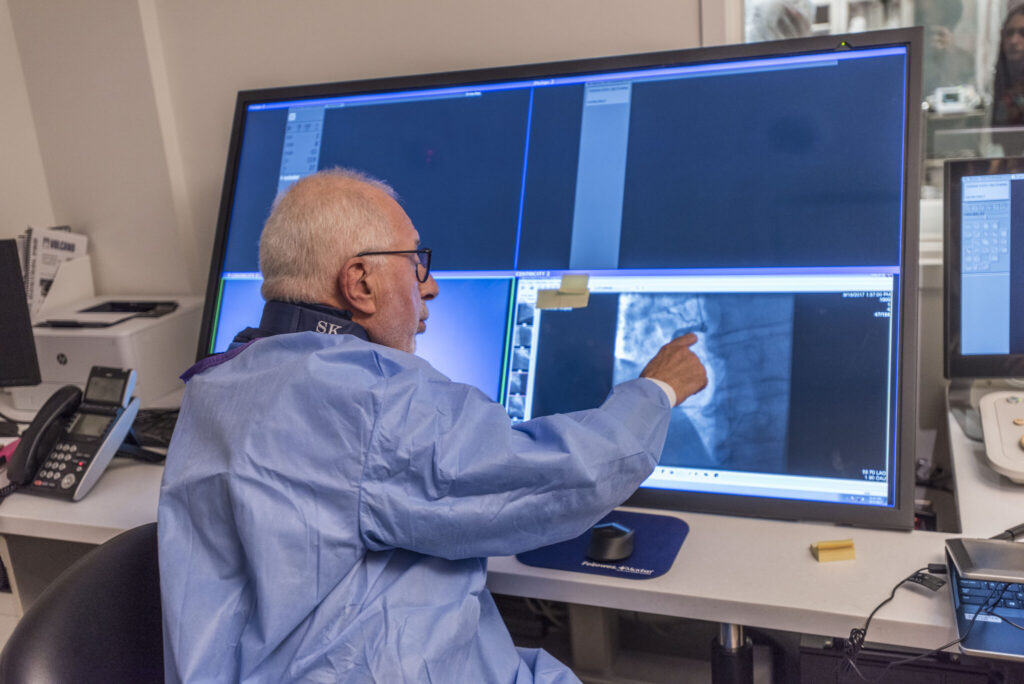
In the early days of Peconic Bay Medical Center’s cardiac catheterization lab, Dr. Stanley Katz would sit overnight with patients he’d just treated — just to make sure they were comfortable, to answer their questions and to be their advocate.
Andrew Mitchell, PBMC’s former chairman and CEO, still vividly remembers those nights.
“There are many patients today who’ve gone through heart attacks and been brought to the hospital,” Mr. Mitchell said. “They’re alive today because of what Stanley did.”
Early years and the path to medicine
Growing up in Cape Town, South Africa, medicine wasn’t something Dr. Katz ever imagined for himself. He recently celebrated his 79th birthday, but still recalls wanting to be what many boys dreamed of: a professional soccer player.
“Medicine was the last thing on my mind, because I would get queasy in biology class and passed out at my cousin’s bris,” the silver-haired surgeon recalled in a sit-down with the Riverhead News-Review. “But then I desperately wanted to get out of South Africa. It was, at the time, Apartheid era.”
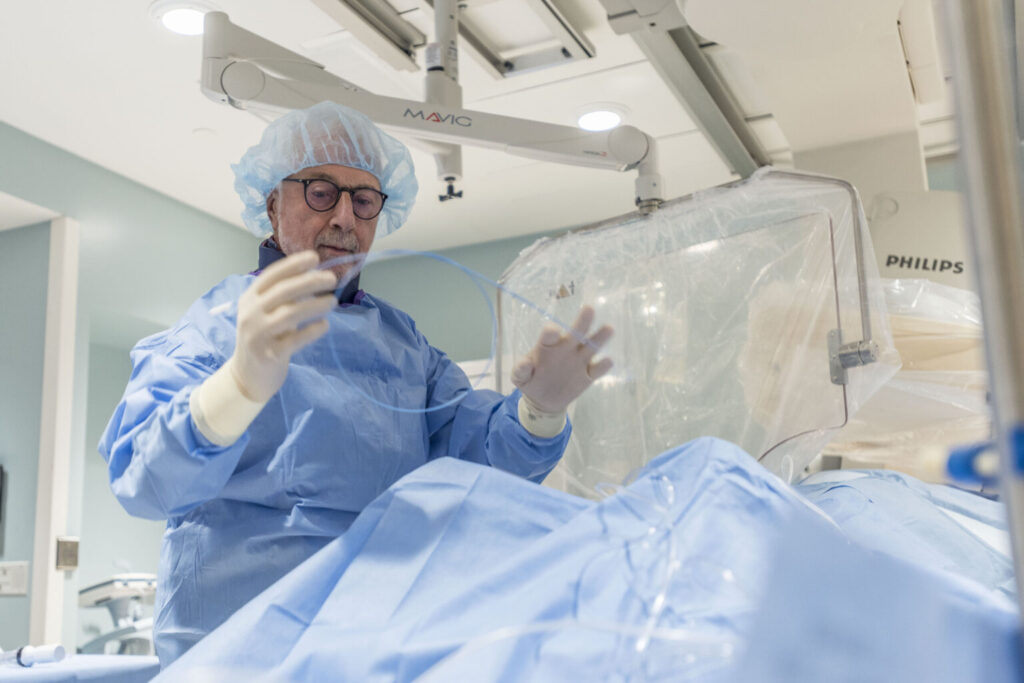
Many of his friends were taking the medicine route for the same reason — a path out of the country. One was already in a program, and when Dr. Katz tagged along to observe a lab, he surprised himself. He didn’t pass out. That realization nudged him toward medicine.
After graduating from the University of Cape Town and interning in Israel, Dr. Katz came to the United States at 26. He spent his 20s and 30s training at Long Island Jewish Medical Center and Montefiore Hospital in the Bronx. He then directed the cath lab at what’s now NYU Langone Hospital–Mineola for nine years before being recruited in 1991 to North Shore University Hospital as chief of cardiology — a position he held for 26 years.
When Dr. Katz started at North Shore in 1991, the hospital was performing 100 stent procedures a year. A decade later, that number had grown to 3,000.
A pilot’s mindset
Outside the operating room, Dr. Katz has another passion: flying. For years, he has piloted a multicolored, four-seat Cirrus out of Francis S. Gabreski Airport in Westhampton Beach, a hobby he picked up in his 50s.
He sees a familiar rhythm between the cockpit and the cath lab.
“When I’m doing a procedure, I’m looking at the monitor, but I’m also looking at the EKG and the blood pressure, and I’m listening to the patient’s respiration,” he said. “It’s the same with aviation. You have to be multitasking and monitoring many different parameters all at the same time. There’s a certain risk-taking with flying and the same with interventional cardiology.”
For him, it’s not the thrill but the problem-solving discipline that connects the two.
Coming to the North Fork
In 2016, on the verge of turning 70, Dr. Katz was told the hospital where he worked wanted to move toward younger leadership. Around the same time, Peconic Bay Medical Center was in talks to join the Northwell system. He knew Mr. Mitchell, who hoped the merger would bring the hospital its first cardiac catheterization lab.
The two spoke, and Dr. Katz expressed interest in coming out himself to help make that a reality. They had dinner, discussed the opportunity and Dr. Katz was hired that year.
“I think what he really set out to do, and what he accomplished, is set out to establish a standard of care that the people on the east end of Long Island deserved,” said Mr. Mitchell, who retired as CEO in 2022 and has since helped raise millions of dollars for the hospital.
The cath lab first opened in an interim operating room on the second floor in 2017, before plans began taking shape for the permanent home of the program: the Kanas Regional Heart Center.
Mr. Mitchell still recalls watching Dr. Katz sit overnight with patients, just as he had done decades earlier — a hallmark of his approach.
“One of the things that I believe really makes a difference in the care of the patient is if they have some kind of medical advocate, because they don’t know enough to ask the right questions,” Dr. Katz said. “So when I take care of a patient, I act as their advocate. I spend time going over everything with them so that I earn their trust.”
Building programs and raising standards
Once the program got going, it grew quickly and gained credibility. In 2023, PBMC’s cath lab was ranked as one of the top 100 labs in the country — out of more than 1,700 nationwide.
Since Dr. Katz came aboard, the hospital has also built a credible electrophysiology program — putting in pacemakers and defibrillators — and expanded its interventional cardiology capabilities. PBMC became a level three trauma center in 2017, and its next goal is becoming thrombectomy-capable for strokes.
Looking ahead, Dr. Katz would like to see PBMC become a tertiary hospital, where heart surgeons can perform open-heart procedures. That would eliminate the need to transfer patients west of the medical center.
Mentorship and legacy
PBMC President Amy Loeb, who succeeded Mr. Mitchell, credits much of the hospital’s cardiac program growth to Dr. Katz’s influence. She said he commands deep respect, and that it’s clear from speaking with him how patient-centered he is. She describes him as an extraordinary individual.
Alongside his clinical work, Dr. Katz has made it a priority to mentor the young doctors who work beside him.
“One of Dr. Katz’s famous sayings that I love is, ‘Just say yes,’” she said. “What he has taught those coming behind him is to have that mentality that you must figure out how to find a ‘yes’ for patients. He’s probably trained more interventional cardiologists on this island than anyone else. His fingerprints are literally all over this island and country.”