East End Seaport Museum raises $880K for first phase of Bug Light restoration
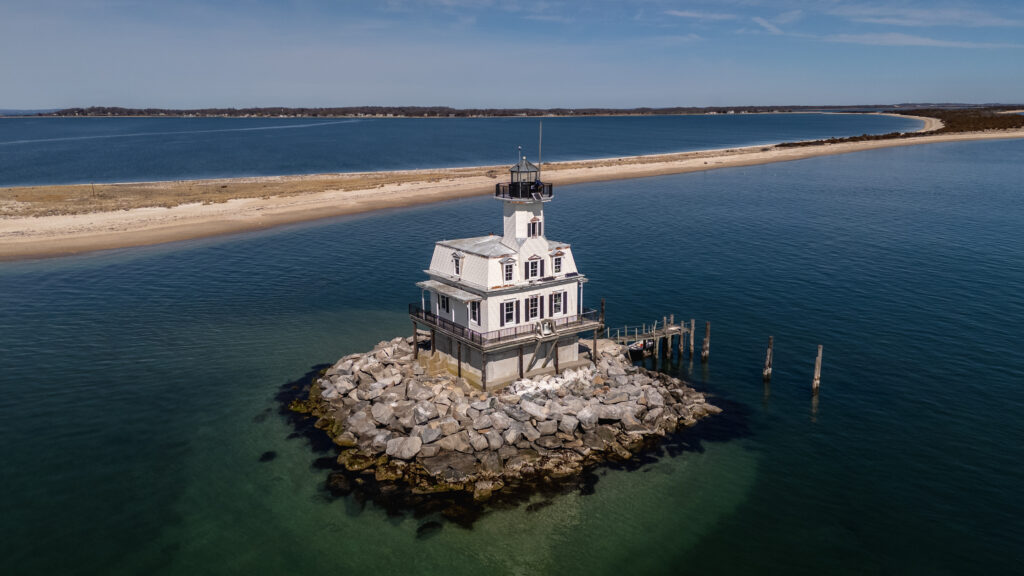
The East End Seaport Museum has raised nearly $1 million for the first phase of restoring historic Bug Light — with construction set to begin next month on the beloved Greenport Harbor landmark.
The museum announced Friday it has secured $880,000 — through state grants and community fundraising efforts — needed to move forward with the “Rock and Dock” phase, restoring the lighthouse that has guided mariners through Gardiners Bay for more than 150 years.
Work on Bug Light, formally known as Long Beach Bar Lighthouse, is expected to be completed by mid-June — in time for the museum’s summer lighthouse cruises.
“Preserving Bug Light begins with its foundation,” museum executive director Erin Kimmel said in a statement. “This critical first step stabilizes the structure and sets the stage for Bug Light’s return as a community landmark for education, culture and inspiration.”
The first phase of the multi-year restoration project will focus on stabilizing the lighthouse’s rockpile foundation and building a new dock, as well as an access ramp, on the small, weather-exposed island in Gardiners Bay where the lighthouse sits.
The museum raised $690,000 from individual community donors, then leveraged two significant matching grants to reach its goal. This included a $293,840 matching grant from the Robert David Lion Gardiner Foundation and a $139,000 matching grant from Empire State Development’s Regional Economic Development Council Capital Funds Program. The total amount of funds raised thus far is just over $1.12 million.
“The matching grants are a powerful affirmation of what our community has already shown — that Bug Light matters,” said Paul Kreiling, museum trustee emeritus and a driving force behind the “Keep Bug Light Shining” campaign.
“Bug Light has always belonged to the community,” said Andrew Wolf, campaign co-chair. “These grants recognize not only the importance of the lighthouse, but the extraordinary commitment of the people who stepped forward early to help save it.”
Marine construction will be led by Westhampton Beach-based Chesterfield Associates, a coastal engineering firm with experience on marine projects from Virginia to Maine. It will require daily marine transport of crews and materials, the use of specialized marine-grade components and the use of high-capacity cranes to place multi-ton stone.
The first phase includes a new 40-foot, two-level pier built with environmentally friendly Greenheart lumber, a 20-foot wave-mitigation screen along the south side of the pier, five dolphin structures to support docking and ice flow, and a new 161-foot walkway formed by installing two-ton, flat-faced granite blocks along the existing perimeter.
“This initial phase focuses on securing safe access to Bug Light and stabilizing its immediate setting,” Ms. Kimmel said in the announcement. “Completing this phase is essential to protecting the site and enabling all subsequent restoration work.”
The restoration project aims to preserve Bug Light — which gets its name because of how the structure was perched atop long screw piles, like stilts, that made it look like a giant, long-legged insect.
The museum’s phased approach is designed to allow visible progress while ensuring fiscal responsibility. Phase 2 — deemed “Lighthouse Urgent Stabilization” — will focus on immediate structural and material interventions necessary to safeguard the building envelope and fabric. It will mitigate ongoing damage while longer-term restoration planning and approvals go forward.
Phase 3 will be called “Full Lighthouse Structure and Exhibit Space Restoration, Enhancements and Maintenance Fund.” It will encompass the comprehensive restoration of the lighthouse structure and the development of interpretive and exhibition spaces. It will also establish a dedicated maintenance and reserve fund to ensure long-term care, stewardship and sustainability.
Future phases will include structural renovations, a wraparound balcony with 360-degree views of Peconic Bay, a patio for community gatherings, upgraded amenities and solar power for energy independence.
From 1871 until the mid-1940s, Bug Light was home to a lightkeeper. This person lived on the second floor and maintained the light — which later switched from a red beacon to a white flash every five seconds — as well as a large bell that still hangs on the west side of the structure and was rung when fog was particularly thick.
During the devastating hurricane of 1938, the lightkeeper and his grandson huddled in a corner on the second floor and somehow survived the massive storm that crossed Peconic Bay from the Shinnecock Canal to Greenport. Waves flooded the first floor and crashed against the second floor.
In 1989, community members formed the Marine Foundation to raise funds to purchase the lighthouse for eventual restoration. That foundation later merged with the East End Seaport Museum to form a single organization dedicated to preserving Bug Light.
Once fully restored, the lighthouse will function as a living history site, offering immersive tours, maritime arts and cultural exhibits and educational programming, including exploration of coastal trade, navigation, lighthouse keeping and the East End’s enduring relationship with the sea.
The East End Seaport Museum is based in the former Long Island Rail Road terminal on Greenport Harbor’s fishing wharf. Through exhibits, lectures, youth programs, cruises and community events, the museum promotes the maritime heritage and history of the East End.
For more information about the restoration campaign or to contribute to future phases, visit eastendseaport.org.