Guest Column: How Greenport parking lots could become housing on the North Fork
The North Fork’s housing crisis is deeply personal to me. In my family’s 16 years as renters here, we have lived variously in Southold, Greenport and Orient. We put up with a lot before lucking out with our current landlord, who keeps our rent remarkably low. Unfortunately, countless friends, co-workers and classmates who were either priced out years ago or are working long hours to get by have not been so lucky.
If these experiences have taught me anything, it’s this: Building more housing is not rocket science. You find open land, and you build.
But North Forkers continue to throw their hands up in the air and say, “There’s nowhere we can build more housing.”
To this, I say: look around you.
Look at all of the empty parking lots, the strip malls, the churches and the yards across the North Fork that could all fit one extra home. The path forward is clear: We find underutilized land near businesses and transit, and we build.
Unfortunately, on the North Fork, there simply isn’t much land for new housing. Forests, wetlands and farmland are all off-limits. Residential neighborhoods cannot add enough housing on their own due to traffic and parking constraints.
Building more housing in our business districts — namely our downtowns and shopping centers — remains our best bet for making as much housing as possible to meaningfully lower prices. These areas have large amounts of underutilized parking space that property owners could transform into apartments — with the appropriate zoning changes, of course. The best part? There would be minimal concerns about parking and traffic, because these new homes would be right next to existing businesses, amenities and public transportation.
Let’s take Greenport Village, for example.
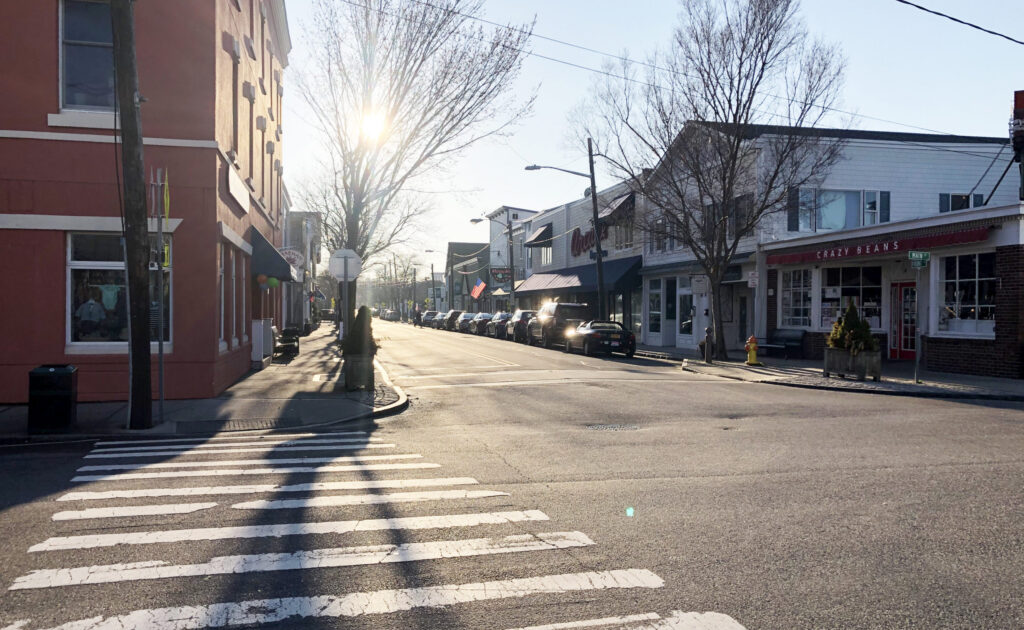
Greenport has multiple properties with big parking lots close to municipal parking, the LIRR station parking or both. Imagine if we allowed the owners of these properties to build apartments — and perhaps small businesses on the first floor — on these parking lots?
These ideas have a valid critique: Removing so much parking makes no sense! Where will all of the cars go?
I am not arguing we should wage an all-out war on parking. Greenport needs a substantial amount of parking — not only as a remote tourist town, but also for those of us who cannot as easily walk.
However, eliminating excessive parking would free up a significant amount of space — not only for new housing, but also for more small businesses and, in turn, a more walkable, vibrant, profitable downtown. And Greenport could get away with it thanks to its strong walkability and transit access.
But don’t businesses need parking to survive? Yes, within reason. But on the whole, it is actually better for businesses to minimize available parking space in a given area.
This is because, to paraphrase urban planning economist Donald Shoup, there is no such thing as free parking; all parking takes up valuable space. Every time you pave over land — or demolish a building — to make a parking lot, you are denying space for housing, businesses or parks.
This has inescapable economic consequences. When businesses are further apart and harder to get to, there is less of a chance someone visiting one business will check out the other. This means businesses surrounded by excessive parking make less money. They also make less money because they’re using more land, which requires higher maintenance costs and higher taxes. That’s right: Too much parking is bad for business.
Greenport’s new prohibitive parking requirements are currently making it too expensive to build valuable businesses and affordable housing. This has noticeably stunted the downtown’s business environment — just look at all of the vacant properties on Front Street.
If we converted parking lots near businesses into housing, it would provide a built-in customer base. It would also provide badly needed workforce housing. And if we redeveloped downtown parking lots into new businesses, all businesses would benefit. People checking out one store are more likely to stop in next door.
Visitors love Greenport. And they especially love to walk around Greenport. So why not expect more of them to take the LIRR or park further away from downtown? In exchange, we would get not only more affordable housing, but also more successful businesses — all without sacrificing protected lands or encroaching on residential neighborhoods.
But why not improve public transportation first to reduce driving incentives? you may ask.
Because people will oppose public transportation investments as long as they can already drive. We should do both at the same time, but we cannot do the carrot without the stick. Moreover, converting parking into housing and businesses would create more demand for transit, which is the best way to justify making transit better funded, more comprehensive and more reliable.
Former mayor Dave Kapell put it best at a hearing last August: “What’s more important for the people and future of Greenport — a place to live and raise a family, or a place to park your car?”
With a nuanced, long-term, targeted approach, we can gradually convert more and more underutilized land in our downtowns into affordable housing and successful businesses.
All it takes is going for a walk around your town, squinting your eyes at that vacant parking lot and reimagining what’s possible.
Liam Rue graduated from Greenport High School in 2021 and holds a dual degree in political science and Spanish from UMass/Amherst’s Commonwealth Honors College.