Sinking charter boat leaks fuel, poses environmental threat in Mattituck Inlet
This story has been updated with additional information about the cleanup response.
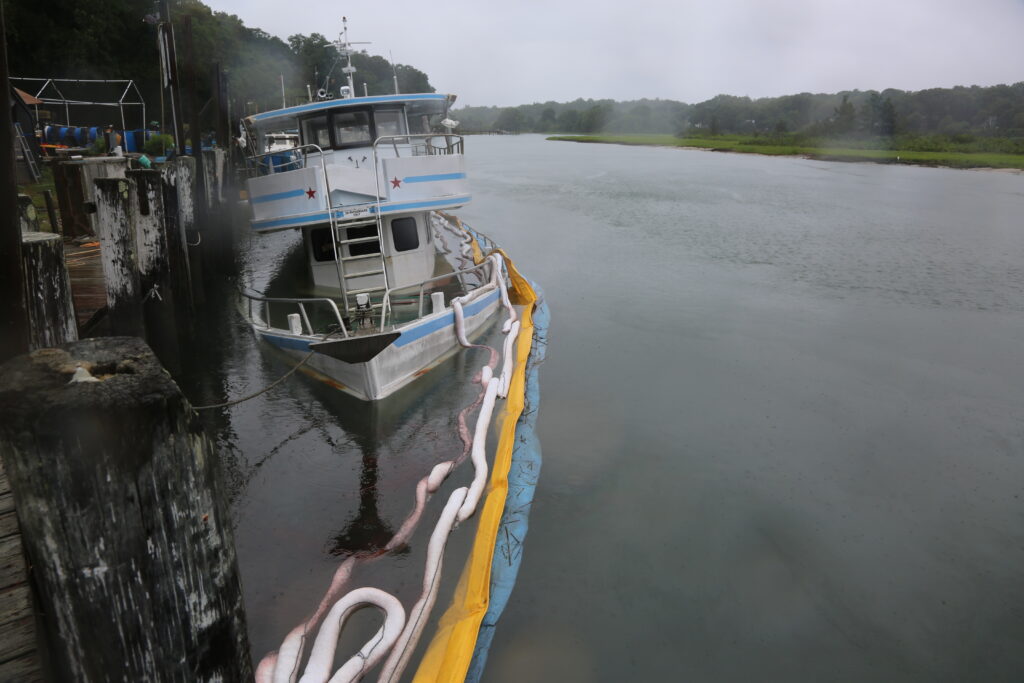
An abandoned charter boat that partially sank in Mattituck Creek is leaking diesel fuel into the waterway — prompting a state and federal cleanup effort in one of the North Fork’s most productive estuaries.
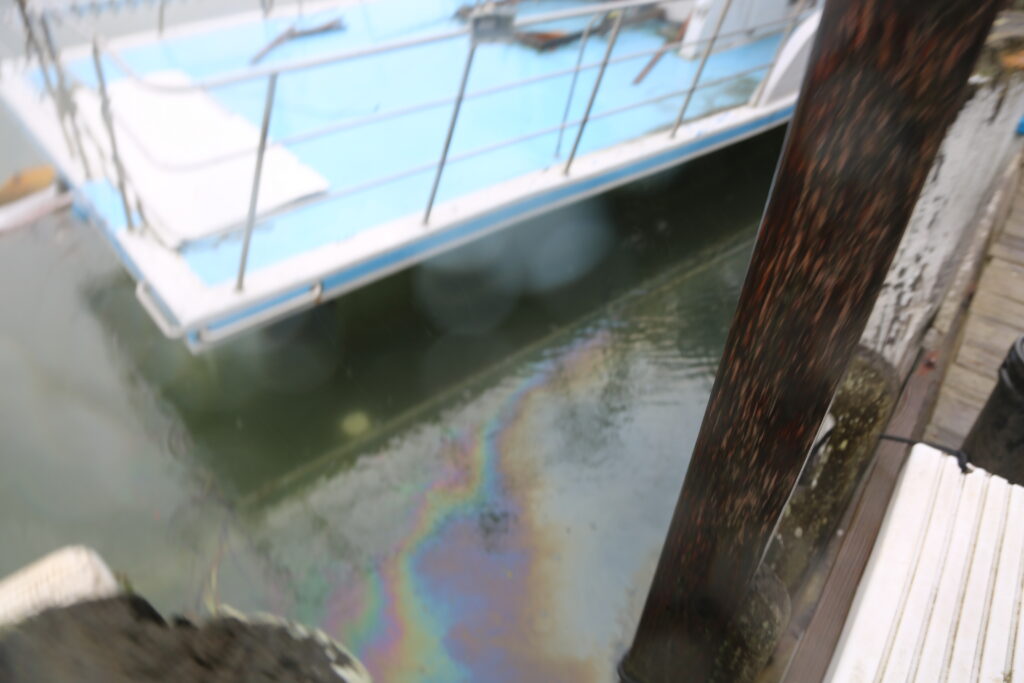
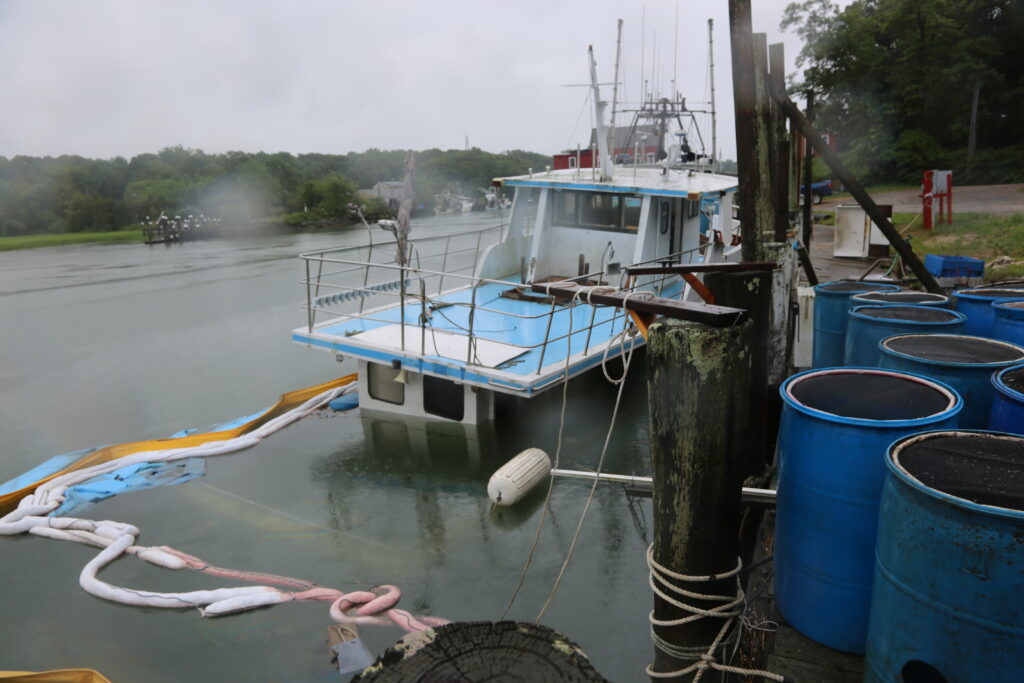
The roughly 60-foot boat, tied up at a private commercial dock, sat low in the water Monday afternoon, its lower cabin largely submerged as it leaned sharply against the dock. Yellow, blue, white and pink pollution-control boom surrounded the vessel, but a rainbow-colored fuel sheen was still visible against the dock and a strong diesel odor hung over the rain-swept creek.
Stay in the know! Sign up for the Suffolk Times daily newsletter
For a waterway that has spent decades being cleaned up, the sinking boat is more than an eyesore. It is an environmental threat unfolding in real time.
Jimmy King, a former Southold Town Trustee who served from 1994 to 2015, said he has been keeping tabs on the boat from his nearby home since he first noticed it taking on water last Tuesday.
He said bay constables responded that day, but he was told there was not much they could do.
Mr. King, who has fished the waters around Mattituck Inlet for 60 years, said he then boarded the vessel himself and used a submersible pump he found there to drain water and keep it afloat.
By Saturday, he said, the boat had started sinking again.
“This was all preventable,” he said. “It’s a disgrace.”
Mattituck Creek resident Ed Smith said he had also been watching the oil slick spread across the water as a cleanup crew arrived Tuesday.
“It’s not good,” Mr. Smith said. “There’s a lot of diesel and oil floating around the creek.”
The Coast Guard received a report around 5:30 p.m. Sunday that an abandoned vessel had sunk at a pier in Mattituck Inlet and was presumably leaking fuel, Coast Guard spokesperson Viviana Cintron-Ortiz told The Suffolk Times on Tuesday.
Coast Guard Marine Safety Unit inspectors responded and assessed the vessel. Boom was later deployed around the boat to absorb fuel, and the response remains ongoing, she said.
The cause of the incident and the amount of diesel on the vessel and in the water remain unknown, Ms. Cintron-Ortiz said.
The responsible party is typically responsible for removing a vessel, but the owner is unknown at this time, she said.
DEC is working with the Coast Guard to remediate the site and pump the remaining diesel from the vessel’s fuel tank, according to a person with knowledge of the situation.
The remediation of the diesel fuel release will be covered by the Coast Guard and the New York State Spill Fund, the source said.
That is little solace to a nearby oyster farmer, who asked not to be named because of concerns about his business. His operation has about 1 million oysters seeded nearby. One farm worker said it takes about two years for oyster seed to grow to market size, and that the beds are buried deep in the creek.
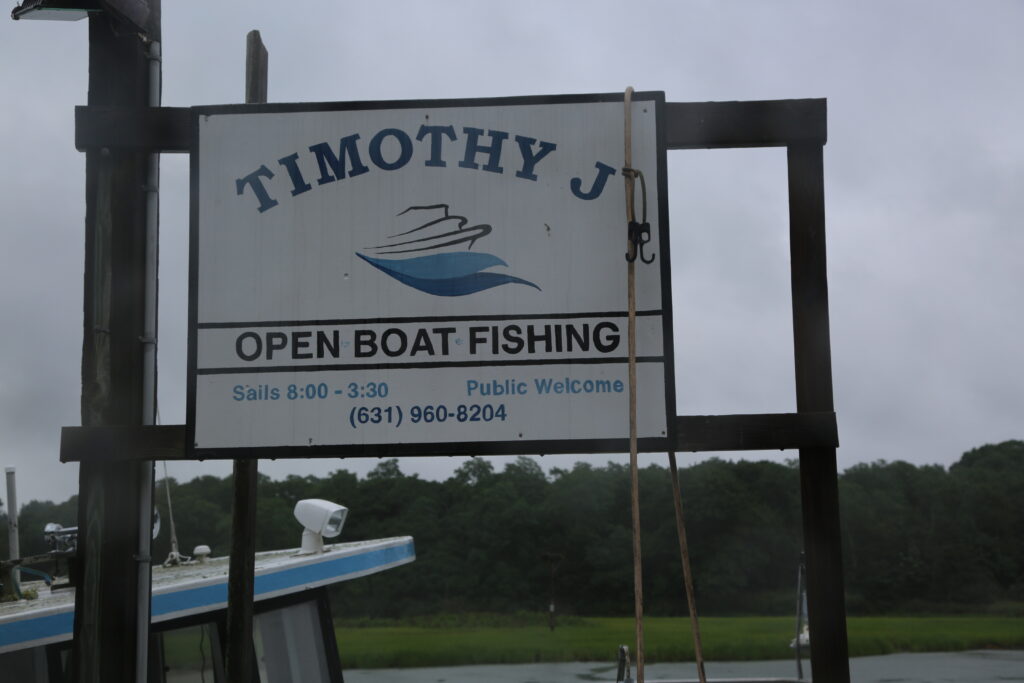
The vessel was apparently part of a charter service called Timothy J Open Boat Fishing. A number listed on a sign for the company at the dock has been disconnected.
Local residents say the boat has sat abandoned for at least a year. The private dock is owned by Dan Cooke, according to a person familiar with the dock.
The Suffolk Times reached out to Mr. Cooke and DEC for comment.
Southold Police Chief Steven Grattan said Monday that town harbormasters, DEC, the Coast Guard and the town attorney’s office have been communicating about the situation.
“Everybody has an interest here in making sure that diesel fuel doesn’t leak into the water,” town attorney Ben Johnson said. “When I hear diesel fuel leaking into the creek, we can’t really mince words and wait around for very long. We have to take some action.”
Southold Town Supervisor Al Krupski said Mattituck Inlet has been the focus of decades of county work to improve water quality and expand shellfishing opportunities.
“The county did a tremendous amount of drainage work there, and as a result it really paid off as far as water quality,” Mr. Krupski said.