Southold Town residents clash over proposed Mattituck oyster operation
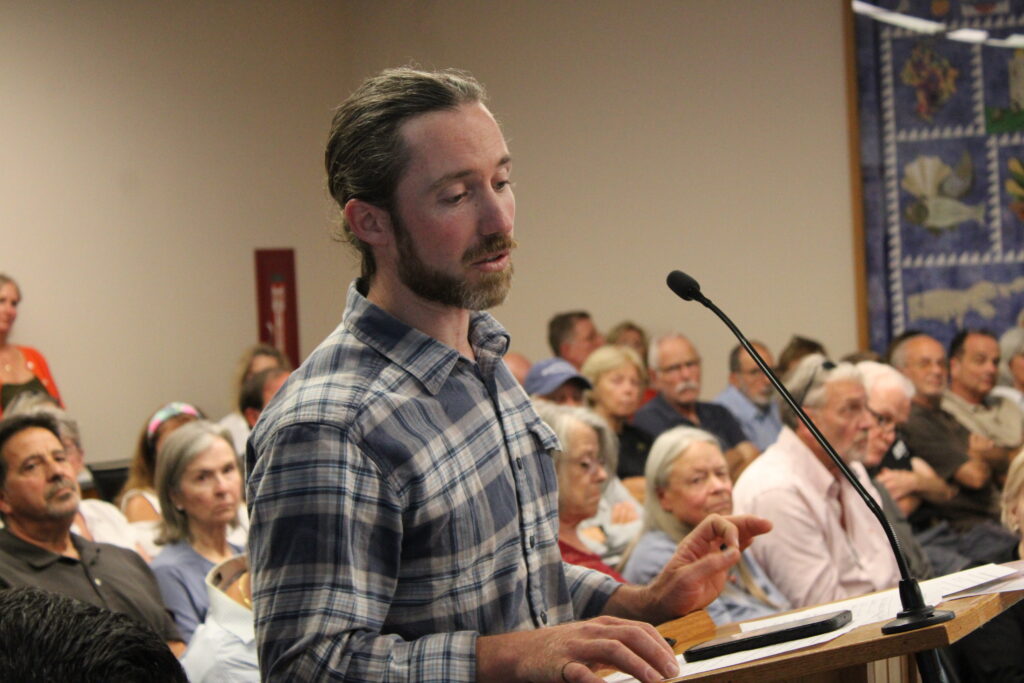
A proposed aquaculture operation in Mattituck packed people — with over 20 speaking up — into Southold Town Hall like a bed of oysters on Monday, with community members battling on both sides of the argument over what can be done on preserved North Fork land.
Will Peckham, co-founder of West Robins Oyster Company, wants to build a farmhouse, farm stand, greenhouse and 3,000-square-foot agricultural building on part of a 14.5-acre property on New Suffolk Avenue, with oyster processing taking up a relatively small portion of the proposed operation.
However, residents who packed the nearly 90-minute hearing feared the project would alter the neighborhood’s character, drawing comparisons to the proposed Southold chicken farm that was recently scrapped.
“There’s a right way and a wrong way for new farming ventures and local residents to live together,” Philip Cammann said about a half hour into the hearing. “Just like there is no place for chicken farms in residential neighborhoods, there is no place for new seafood processing plants in a residential area.”
Mr. Peckham — who purchased the property from Peconic Land Trust in 2023 for $1.6 million — plans to concentrate the development on roughly two acres on the eastern side of the property at 4180 New Suffolk Ave. About 12 acres are protected under an agricultural easement with the Town of Southold.
“I think most people wouldn’t object to a farmhouse and a stand for him to sell his oysters,” said Pete Haack, who lives directly across from the parcel. “Unfortunately, this is now transcending into a commercial operation.”
Mr. Peckham stressed — both at the hearing and a preliminary look he gave residents at Mattituck-Laurel Library on Sept. 1 — that the processing aspect is only a minor part of the proposal and that part of the building would be about 425 square feet.
He also said the property would be connected to public water and already has electricity, eliminating the need for new overhead lines. The project also calls for an innovative and alternative septic system intended to minimize nitrogen pollution.
He plans to shuck and distribute product from other oyster growers as well.
“Processing will be a minority of my business for far into the future, as far as I can tell,” Mr. Peckham said at the hearing. “My intent is to process oysters primarily for my operation.”
Southold Town code requires at least 66% of products processed on an agricultural property to come from that farm’s own operation. Mr. Peckham previously said West Robins currently grows about 600,000 to 700,000 market oysters a year.
Martha Reichert, Mr. Peckham’s counsel, said the project has been designed to comply with town code, and that Peconic Land Trust has approved the site plan, “as they’ve approved every other application that Mr. Peckham has put forward.”
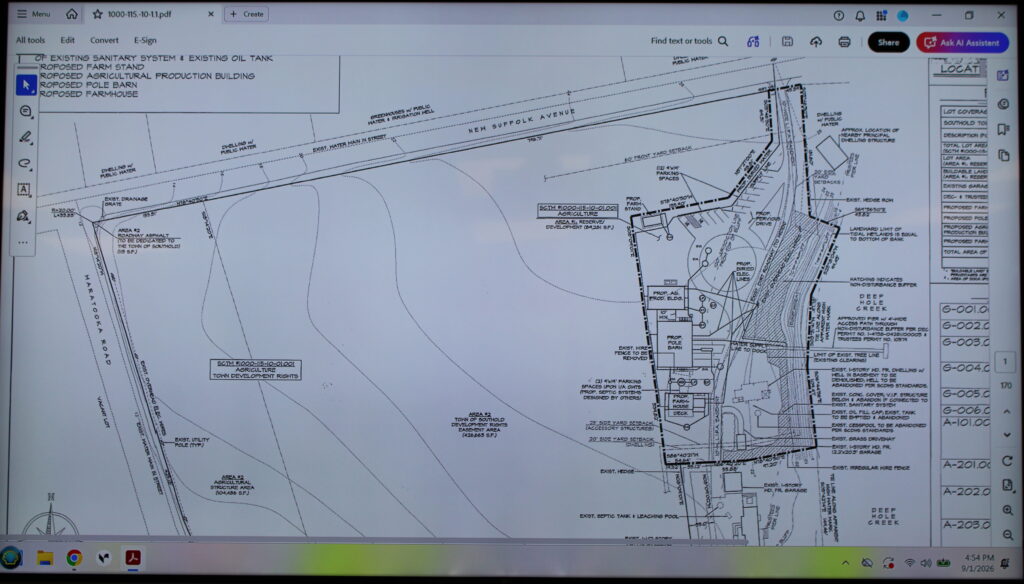
Concerns about the scale, odor and use of Deep Hole Creek did not waver.
“I would not buy my house if that commercial building was there, and I don’t think that’s fair to the people that bought on the lake,” Cheryl Christiano said. “I don’t think having commercial boats going up and down is fair to the people that have been there for all these years.”
But it wasn’t all negative, with numerous residents voicing their support for Mr. Peckham.
“I can’t be prouder of what Mr. Peckham is proposing on this property. It took a lot of hard work,” Aaron Bokros said. “There needs to be more voices of support. As a neighbor and as somebody who lives in that neighborhood, there are those of us who are very, very, very supportive of this project.”
Several supportive residents took Mr. Bokros’ plea to heart, following him with similar sentiments.
“Normally, I might say I would suggest an environmental impact statement… In this case, I would not recommend that because I support what a young farmer is trying to do,” Louise Harrison said. “I support oyster farming.”
Tami Loeffler said her property directly adjoins the parcel, and she is “excited” about the proposal.
“I would much rather see a working boat on the creek than a rich man’s pleasure cruiser that offers no benefit to anyone but the owner,” she said, drawing displeasure from some in the crowd. “We need Will in the community. We need young people, we need farmers, we need hard workers that do real work.”
Bill Edwards, who previously served as both a Town Board member and a member of the Land Preservation Committee, said he has known the parcel for more than 30 years and feared that at some point it would not be saved for agricultural purposes.
“I understand how people are concerned, it is an innovative project,” he said. “Although this wasn’t the farming I expected to see happen there, I think it is an ingenious plan. I’d like to see it succeed.”
Mr. Peckham wanted the community to know that, while it looks different, aquaculture is agriculture. He also said he will be prioritizing “thoughtful development” so as not to worsen conditions around Deep Hole Creek.
He said they won’t be doing a lot of tillage and are growing a lot of vegetables — which he said are already feeding about 40 families.
“I hope that over time this property transitions from something that is causing a lot of productive conversations to something the community can be proud of,” he said. “Despite all the all the noise, I’m still extremely grateful that the community decided to do this and that we don’t have eight houses in the field. I think that holding on to farmland, however, whenever we can, is the right thing to do.”
The oral portion of the public hearing was closed, but written comment may be submitted for 30 days.