After nearly two centuries, Orient Country Store remains a North Fork mainstay
Running a mom-and-pop shop like the Orient Country Store in the 21st century comes with challenges the Founding Fathers never imagined.
Amazon delivers in hours. Walmart undercuts on price. Insurance premiums spike after every nor’easter. Vendors drop you because the trip isn’t worth the gas. Credit card companies take their cut of every transaction. The rent keeps climbing, or the roof needs replacing or the health inspector has new requirements — sometimes all three at once.
As America celebrates its 250th birthday on July 4, there’s only one store on a quiet stretch of Village Lane in Orient that has managed to overcome those obstacles quietly since first opening its doors a few decades after the signing of the Declaration of Independence.
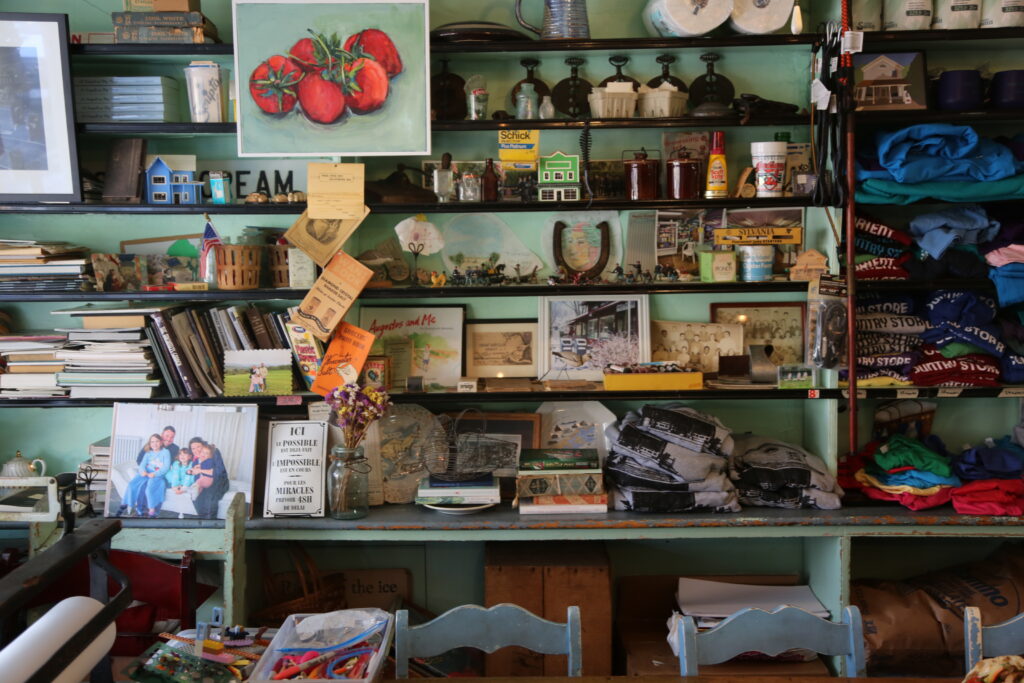
The Orient Country Store has been serving customers since the early 1830s, based on account books kept by its founder, Marvin Holmes, according to local historian Amy Folk. But the building at 950 Village Lane is older still. Its stone rubble basement and hand-hewn locust posts date to the pre-Revolutionary era. The floorboards behind the counter have been worn into gentle valleys where customers line up at the register, generations of feet standing in nearly the same spots.
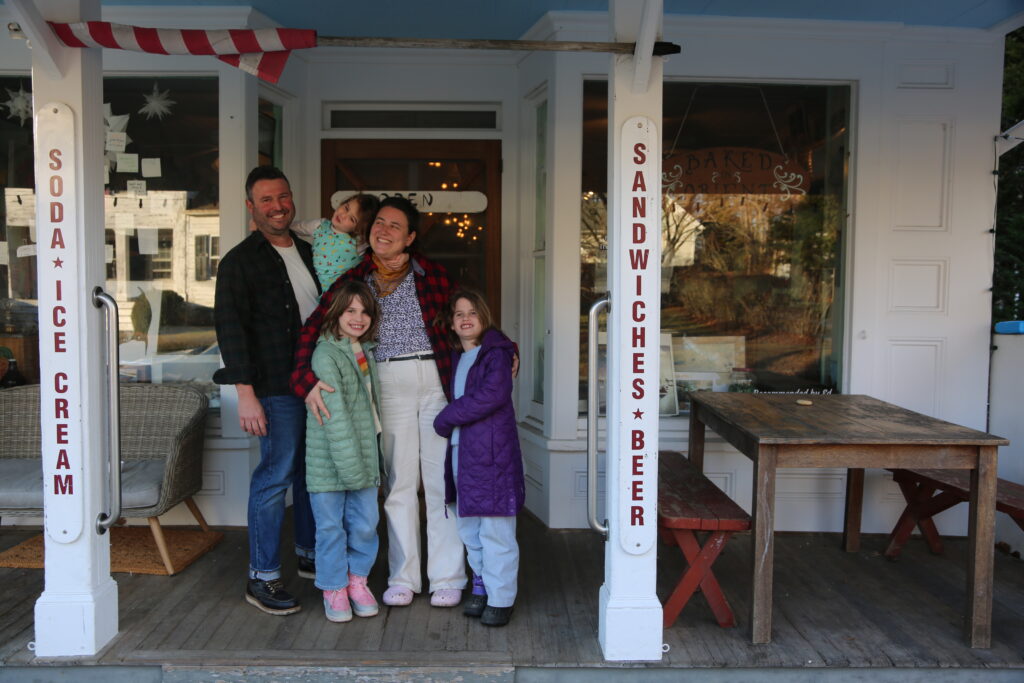
The current owners don’t look like caretakers of a piece of 19th-century history. When Miriam Foster and Grayson Murphy bought the store in 2011, they were 24 years old with art degrees, no business experience and barely any knowledge of Orient itself. They had been living in the Berkshires — with her baking at an inn and him making chocolate — when a failed farm deal led them, more or less accidentally, to the rustic general store at the end of Long Island.
Fifteen years later, they’re raising three daughters here, working five days a week and still figuring things out as they go.
“We think of ourselves as more of custodians than owners because we’re not going to be here until the end of it, but it will survive us,” Miriam says as her 3-year-old daughter, Celia, darts between the aisles.
That survival is now threatened by forces none of the store’s previous owners ever faced: a North Fork pulled between community and commodity.
The Crossroads
The concern runs deeper than daily operations. Deep-pocketed buyers are accelerating the Hampton-ization of the tight-knit community, forcing a decision about what kind of place it wants to be.
“If we can’t keep the North Fork as community-based and as small business-oriented, then this life will not exist if franchises start to come in and housing doesn’t stay affordable,” Miriam says. “There will be no point to us. The regulars won’t be able to live here. There won’t be young people, there won’t be young families. It will just be a summer haven, and we’re not interested in living in a place like that.”
Grayson is more blunt.
“A small mom-and-pop place like this just can’t compete with restaurant groups.”
They look to the South Fork as a warning, where development and money reshaped who could afford to stay year-round. Property values soared. Year-round residents moved out. The character changed.
Orient village still has one restaurant, one antique store and a seasonal ice cream stand. The country store fills every other gap. If housing costs price out young families, corporate chains arrive with economies of scale that a single store can’t match. Then, the North Fork becomes a weekend playground instead of a working community, and the store’s business model collapses.
Colin Stevens has watched farms disappear over his 37 years in Orient. His in-laws were farmers who sold their property. The hamlet once had 20 to 30 small farms. Now there are four or five.
“It’s sad,” says Stevens, 81, a retired Suffolk County deputy sheriff who tries to stop by the store once or twice a week. “I’m a big lover of old newspapers. I kind of look back on life instead of forward.”
Asked what Orient would lose if the store closed, Miriam doesn’t pause: “It would be like the felling of an ancient tree. It would be wretched. We couldn’t imagine Orient without the country store. It’s such an institution and a public utility and a charity and a babysitting gig and daycare and therapy.”
The store has survived 195 years of competition. But survival has never depended on being cheaper, faster or more convenient. It has depended on being indispensable.
No Hiding
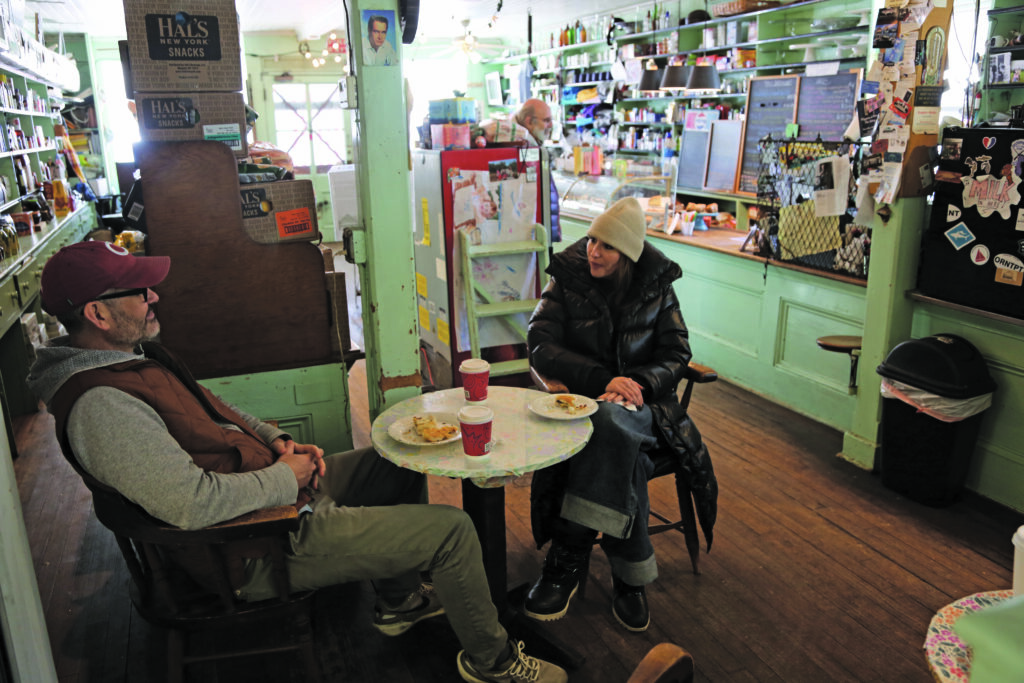
Part of the appeal is that you have to talk to someone at the Orient Country Store. There’s no way around it.
“You come in and every head in the place swings at you,” Miriam says.
That forced interaction is the point. It’s also the business model.
The store functions as Orient’s town hall, bulletin board and social center. During voter registration drives, both parties set up tables outside. Artists display work. Authors do readings. The library hosts toddler story time in summer.
Miriam’s mother lives in Orient now. Her favorite thing is introducing neighbors who’ve lived next door for years but never properly met.
“Since we know just about everything about everybody, we’re able to say, this is who just moved in, or this is who is next to you,” Miriam says.
They still answer the phone for plumber Ed King, who died in 2019. Linton Duell, the previous owner, did it for Ed’s father. It likely goes back further.
Stevens worked for Duell in the early 2000s, filling in when Duell traveled to watch his son play basketball at St. John’s. Back then, the local pharmacist and a retired judge would gather with others to hash out the world’s problems. If someone died in Orient, neighbors would call the store to spread the word.
“If you want to know what’s happening in Orient, that’s the first place to go,” Stevens says.
The vibe has shifted under new ownership — Duell ran a more conservative operation with a small grill and basic menu — but the role hasn’t changed.
“You don’t feel like you’re in a store,” Stevens says. “You feel like you’re visiting family.”
Miriam is what Stevens calls “an excellent conversationalist,” the kind who chats with customers about holidays and families and babies like “two women hanging over the back fence or hanging over the clothesline.”
Stevens tries to avoid stopping in too often. When he does, he ends up staying for hours.
Regulars come in multiple times a day. If someone doesn’t show up, neighbors check on them. Before Grayson became an EMT, they were taking people to the ER, picking them up from rehab, getting groceries for shut-ins and giving kids rides after school.
“People let us be part of their lives,” Miriam says. “I’ve met all my best friends working at the store.”
This isn’t nostalgia. It’s a competitive advantage built on noticing when someone hasn’t come in by noon.
Independent grocers nationwide have survived by retreating to margins — rural towns too small for chains, urban neighborhoods too poor to attract them. According to the National Grocers Association, roughly 21,500 independent grocers remain by filling gaps larger operators won’t touch.
Orient doesn’t fit that mold. Greenport sits seven miles west with a supermarket. Southold is a few miles farther down the road. The store doesn’t survive because there’s nowhere else to shop.
It survives because of something Walmart can’t replicate: being the place where everyone knows you’re coming before you walk through the door.
Stevens puts it differently: “I don’t have to travel around the world. The world comes to the country store.”
The Math
Nonetheless, the shop runs on razor-thin margins, especially in winter, in what Miriam calls “a nickel-and-dime business.”
Winter means 70% groceries, 30% prepared food. Summer flips that split.
“We’re basically two different businesses,” Grayson says. “A summer business and an off-season business.”
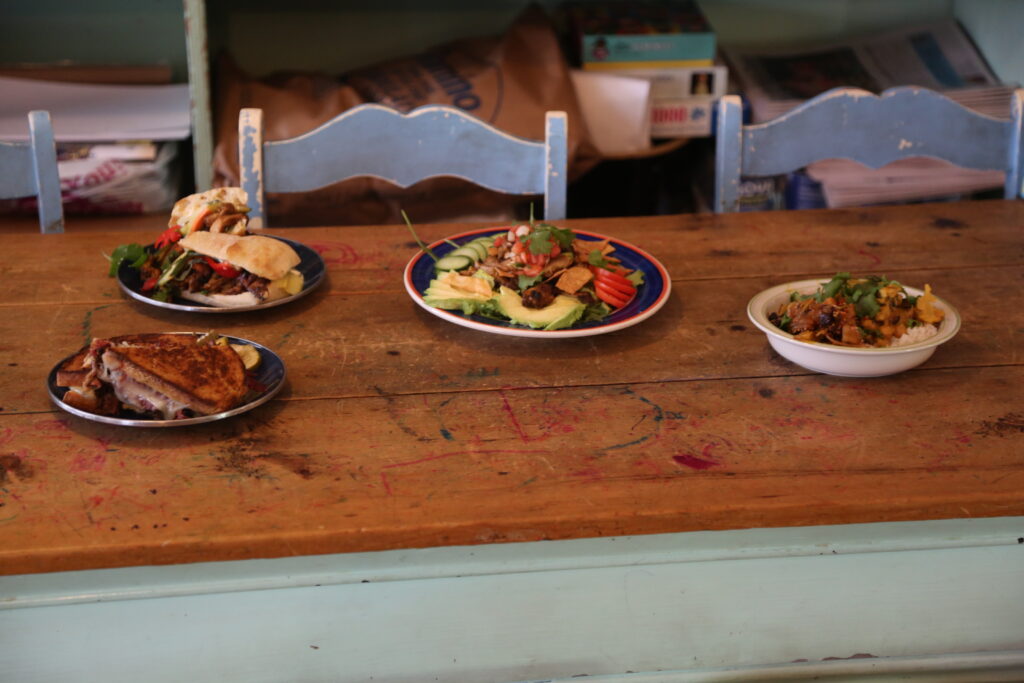
Grayson handles the savory offerings. His Reuben sandwich requires seven napkins, according to Stevens.
“Katz’s Deli in the city has nothing on the country store,” he says. “The meat just melts in your mouth.”
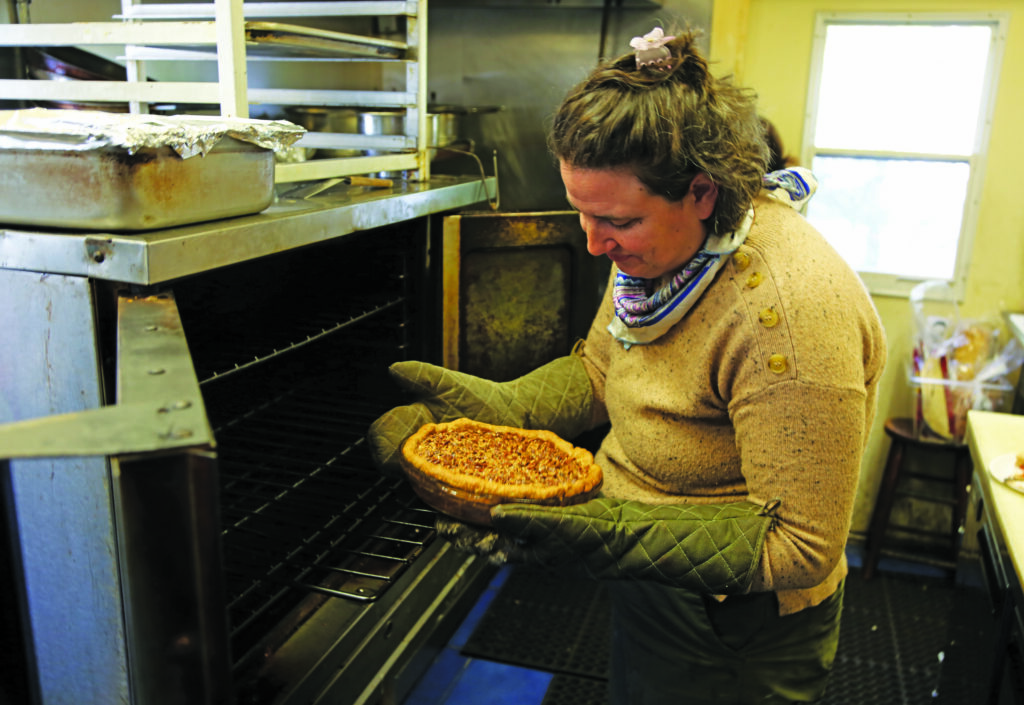
Miriam provides the sweet treats, including her blueberry pie.
Being at the North Fork’s eastern tip creates problems.
“We’re at the end of the line for deliveries,” Grayson says. “Over the years, we’ve had quite a few vendors drop us. It’s just not worth it.”
Post-Sandy, insurance became brutal.
“We’re lucky to have insurance, basically,” Miriam says. “That’s what our insurance broker keeps telling us.”
Major expenses hit hard: a new roof, a water filtration system, constant maintenance on a building this old. Owning the building helps.
“The money and time you’re putting in comes through on the back end,” Grayson says, “and we don’t have to ask too many people’s permission to change things around.”
After dealing with COVID and the fallout that hit many businesses, big and small, the couple has managed to right the financial ship. Last year was “really good,” the couple says, though they won’t quantify growth.
Asked whether the business is more stable than Year One, Miriam’s answer is definitive: “Yep, we figured it out.”
They employ a small crew. A couple of people handle kitchen prep. Summer brings two extra teens. The core is Miriam and Grayson, five days a week.
“There’s not a lot of room,” Miriam says. “When I was pregnant with the twins, I couldn’t even fit back there.”
They’re making it work when they shouldn’t be able to.
“We don’t have a $20 breakfast burrito,” Grayson says. “This is still the North Fork.”
What Changed, What Didn’t
When they took over in 2011, they had no business plan — just a willingness to work and a belief that food could be better.
Grayson realized immediately they needed a real kitchen.
“We had a hot plate,” he recalls. “That wasn’t gonna fly.”
The store they inherited sold canned soup, Quaker Oats, beer, soda and what Miriam describes as “Saltine and Kraft macaroni.” Baked goods came out of Entenmann’s boxes.
Now Miriam’s blueberry muffins come out by 8 a.m. Grayson’s sandwiches and salads have a following. The menu includes Thai basil chicken sandwiches, curry rice bowls and breakfast burritos rooted in his South Texas childhood. Customers can choose from four or five different breads.
“It’s evolved under our ownership to be a place we can actually work in,” Miriam says. “We will buy and stock what we also use at home. So it’s evolved from the Saltine and Kraft macaroni a little bit more — not fancy, but a little bit more mindful.”
They replaced a dated deli case with custom built-ins. Pendant lights focus on the bakery display in the front window. The side yard went from a dog run to a seating area that fills up in summer. Major repairs followed: sagging eaves, water filtration and constant maintenance on a structure approaching two centuries old.
What they refuse to add matters more than what they’ve changed.
No self-checkout. No online ordering. No iPad spinning around for tips. The answering machine tells callers they don’t check it — and they mean it.
“We resist automation,” Miriam says. “Just the soullessness of these iPads.”
She uses a push-button register and has memorized every price over the years because she has to type each one in.
“I wouldn’t want it any other way. I wouldn’t want a bar scanner. That’s just not us,” she says.
They didn’t take credit cards for the first couple of years either.
“The merchant pays for all the vacations, you know, all those fees,” Grayson notes.
Eventually, practicality won.
Early on, they bent backward for customers, working seven days a week and staying open late. Over time, they found boundaries.
“We figured out what the business is and what it needs and what we need,” Miriam says. “We were very conscious of the needs of our customers, and now we are established enough to offer what we want, and the customer conforms.”
That confidence took 15 years to earn. The store is open Thursday through Monday, 8:30 a.m. to 3 p.m. — even during the busy summer season.
“We don’t change the hours during the summer so that we can get some time with the kids,” Grayson says.
Stevens jokes that even the weekend homeowners from New York City who discover the store wouldn’t want it modernized.
“They wouldn’t want the store to change one iota,” he says. “They like the store just the way it is.”
The Handoff
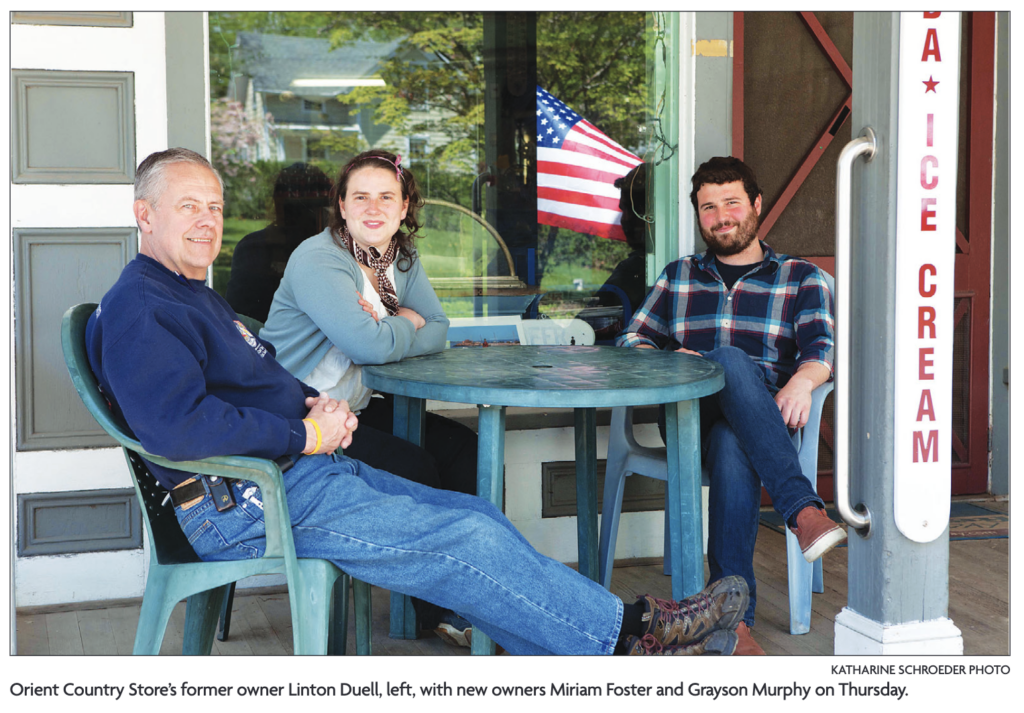
In April 2011, Linton Duell was quietly considering retirement. He had been back in his hometown running the store since 1980, after eight years in Hawaii. Selling required discretion. Orient’s only general store becoming a yoga studio or boutique would have been a disaster.
When he met Miriam and Grayson, something clicked.
“I believe that he recognized in us something of himself when he was a young man coming back to his community,” Miriam says. “Although we were newcomers, he recognized that we would care for this place, that we wouldn’t corrupt it. So he took a chance.”
Duell’s advice was simple: Don’t change things quickly.
They did swap Styrofoam coffee cups for paper immediately. The regulars revolted. In a compromise, the store bought mugs.
Duell also warned them not to take charge accounts. He had three customers on account when he sold.
“We’ve outlasted them all. None of those people are alive anymore,” Miriam says.
The first month was quiet. Then Memorial Day arrived, and Miriam left to attend a wedding in France.
Grayson recruited his parents to help. His father worked the register. His mother poured coffee. Grayson cooked.
“I saw the parade walk down, and they all just came in here,” Grayson remembers. “I was like, ‘OK, people do come to this place.’”
Stevens wasn’t worried when the two 24-year-olds with art degrees took over. He saw immediately they were “just nice kids” without attitude who “blended into the community perfectly.”
Grayson became a fire department commissioner, company secretary and treasurer. Miriam got involved with the school board.
Fifteen years later, people still come — not just for groceries, but for connection.
The Chain of Custody
Before Miriam and Grayson, Duell ran the store for 31 years. Before him came Wilbur and Lorene Young, and before them Elbert “Bert” Luce, who held it for 55 years.
The ownership chain stretches back to the 1830s. Gilbert Terry sold the store to Luce after deciding he didn’t like running it, says Folk, curator of collections at the Oysterponds Historical Society. Gilbert’s parents, George and Gertrude Holmes Terry, operated it before him — Gertrude inheriting the business from her father, Marvin Holmes, who started it with his son.
Holmes, born in 1800, began the business around 1831, according to surviving account books. The 1873 Beers atlas depicts Marvin Holmes and his son operating the store. Holmes also ran a school teaching navigation to mariners and kept the district school for nearly six years. When Orient got its first post office in 1836, it was likely housed in the store.
It hasn’t always been called the Orient Country Store. When Luce owned it, he joined a cooperative of independent grocers called Royal Scarlett — a strategy small stores used to compete with chains, Folk says. A photograph from around 1920 shows the store operating under the Royal Scarlett name, one of several Royal Scarlett locations across the North Fork. The name changed to Orient Country Store sometime during Wilbur Young or Linton Duell’s ownership.
A 1962 newspaper article marking Young’s purchase from Luce captures how dramatically the store had changed even then. In earlier days, customers arrived by wagon or buggy, tying up at hitching posts on the dirt lane. Luce sold everything from crackers to cotton goods, grain to kerosene, corsets to overshoes. The store opened six days a week before the clock struck seven. Almost everything had to be weighed — loose dried fruits, flour from barrels, even molasses dripping into catch pans.
By 1962, cake mixes and canned goods had replaced the bulk goods. The horse sheds were gone. But the building remained, and customers who’d run down for penny candy in 1908 were still shopping there in their old age.
The building was remodeled in 1963, but walking through today still means moving between centuries. Original 19th-century counters line the walls. The floor has been repaired where customers congregate most, where the wood had gone soggy under the weight of nearly two centuries of footsteps.
Miriam points to the valleys behind the register.
“We had to repair it, but we tried to keep the floor the way it is.”
Mounted in a window is an old chart of accounts, handwritten ledger pages showing who owed what. The names are familiar: Tuthill, Wickham, King. The same families still live on the North Fork, still shop here and sometimes still deliver vegetables from the same farms their ancestors worked.
The old Rod and Gun Club fishing scale hangs on the wall. There are three registers: the push-button model Miriam uses, an ornate National Register with marble and brass from an earlier era, and the handwritten account book that predates mechanical tallying.
Holding It For A While
The school bus drops off Celia’s older sisters, 8-year-old twins Tamsin and Ry, at the front door every afternoon. Customers have babysat the girls since birth, with some becoming godparents. The family lives upstairs.
“It’s very old fashioned in that way,” Miriam says. “Very community-based, community-oriented.”
When the store closes for two weeks at Christmas so the family can visit Grayson’s relatives in Texas, regulars joke that everyone goes on a diet.
The three girls are growing up in a building that has seen generations of American history, learning what it means to be part of something that matters.
Asked what she would tell whoever owns the store in 2076, when America celebrates its 300th birthday, Miriam offers what could be the store’s entire philosophy: “Look back to get the answers for the future. Stay the course.”
This article first appeared in the Times Review Media Group’s annual Business magazine, which was published this month.