Southold ‘losing the war’ against deer as tick-borne illnesses persist

The North Fork’s exploding deer population prompted Southold Supervisor Al Krupski to agree the town is “losing the war” in its effort to thin the herd — as tick-borne illnesses continue to plague the North Fork.
The scale of Southold’s deer problem came into focus during Mr. Krupski’s State of the Town address last Thursday, when a resident declared, “We’re losing the war.”
“We are, there’s no question,” Mr. Krupski told the packed crowd at the Peconic Landing Community Center during a Q&A session after his wide-ranging speech. “Overall, we have to take out about 60% of the deer population every year, just to maintain the population. We know that there’s a huge problem.”
The problem is difficult to miss on the North Fork, where groups of deer are a common sight along roads from dusk to dawn.
For Mr. Krupski, the transformation has happened within his lifetime. He said deer were virtually nonexistent on the North Fork when he was growing up, before more fallow land and changing habitat helped the population expand.
“They stand there and look at you,” Mr. Krupski said.
Deer are particularly important to the life cycle of blacklegged ticks, which can transmit Lyme disease. Adult females commonly feed and mate on deer before dropping off and laying eggs, allowing large deer populations to support large numbers of ticks.
Suffolk County recorded 3,152 Lyme disease cases in 2024, the latest finalized county data available, after 3,299 in 2023 and 2,668 in 2022. County health officials caution that New York changed its Lyme disease reporting methodology in 2022, making direct comparisons with earlier years difficult.
The North Fork’s tick problem has remained particularly visible this year. The Suffolk Times reported in May that emergency departments across the Northeast were seeing tick bites at their highest level for that point in the year in nearly a decade, according to the Centers for Disease Control and Prevention.
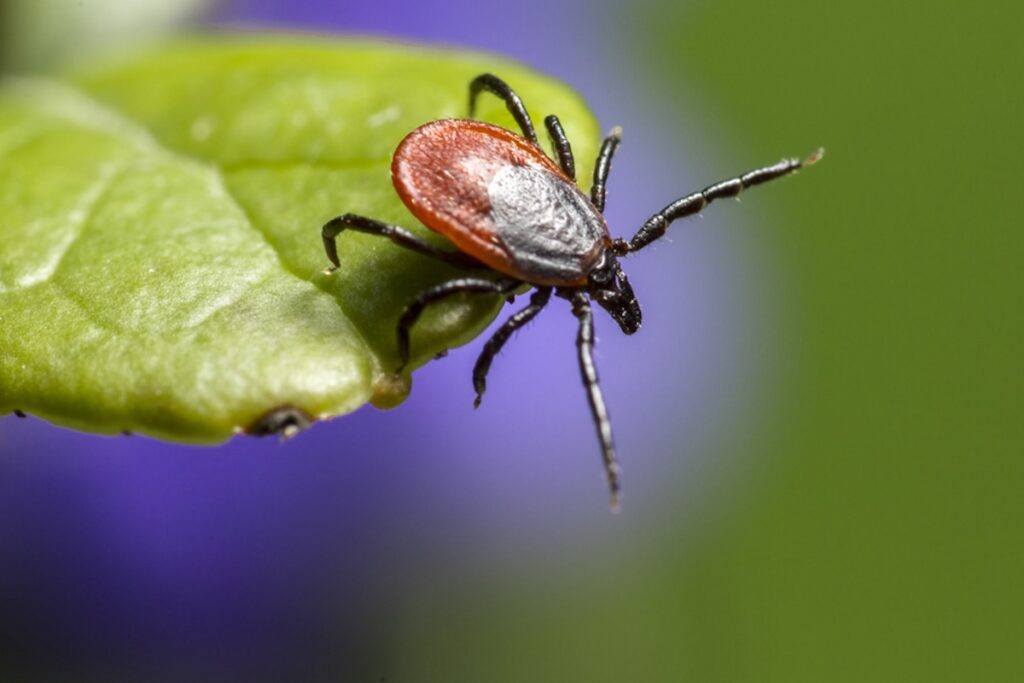
The region has confronted other emerging tick threats in recent years as well. The Suffolk Times has reported extensively on the spread of lone star ticks and alpha-gal syndrome, an allergy to red meat that can develop after a lone star tick bite. This summer, Suffolk health officials have also reported probable cases of tularemia, a rare bacterial disease that can be transmitted by ticks as well as through contact with infected animals and other routes.
Dr. John Rasweiler, a wildlife scientist who has served on Southold’s deer management committee since 2009 and on Suffolk County’s Tick Control Advisory Committee since 2014, said deer serve as reproductive hosts for blacklegged ticks, with individual animals capable of feeding large numbers of adult ticks through their reproductive cycle.
But tick-borne illness is only one consequence officials attribute to the oversized herd. Southold Town police recorded 183 deer-related vehicle collisions in 2025, according to data provided by Police Chief Steven Grattan. That followed 227 in 2024, 207 in 2023, 180 in 2022, 206 in 2021 and 247 in 2020.
The Suffolk Times reported in 2024 that Suffolk ranked third among New York’s 62 counties for animal-involved crashes the previous year.
Over the last year, there have been 215 deer carcasses removed from State Route 25 on the North Fork, including 15 in June and 13 in July, according to Stephen Canzoneri from the NYS Department of Transportation.
Dr. Rasweiler said heavy deer browsing is also preventing forest regeneration and stripping native understory vegetation, while farmers must increasingly fence fields and orchards to protect crops.
Estimates have placed Southold’s herd at roughly 65 to 75 deer per square mile, according to Dr. Rasweiler.
He said an environmentally sustainable level would be closer to 10 to 15 per square mile, and that some areas of eastern Long Island have exceeded 100.
Those estimates are consistent with concerns local officials and wildlife experts have raised for years. When Gov. Kathy Hochul signed a Southold-specific deer management law in 2023, experts estimated that roughly 3,000 deer lived in the town — several times the 500 to 600 they said its approximately 60 square miles could sustainably support.
The law, which took effect in 2024, allows trained state or federal contractors working under state Department of Environmental Conservation supervision to use more aggressive methods to reduce Southold’s herd. It was adopted after years of warnings that recreational hunting was making too small a dent in the population.
“We’ve had a very good deer management committee for about two decades, and that was part of the beginnings of that,” Mr. Krupski said. “But we could never keep up with the exploding population.”
Councilwoman Alexa Suess said the town is again seeking state support to expand its ability to control the herd, including the use of trained sharpshooters and professional deer removal.
“However, when populations are this high, it’s important to note that recreational hunting cannot control it alone,” Ms. Suess said. “Hunting is a time intensive and physically demanding activity, and even with the deer management strategies that we have in place, populations continue to grow.”
It remains unclear what additional state approval or regulatory change Southold is seeking beyond the authority granted under the 2023 law.
The town already works with the DEC to allow hunters to take additional antlerless deer by bow and provides refrigerated storage during hunting season where harvested deer can be left for processing and donation to local food pantries.
Ms. Suess said more than 80,000 pounds of venison have been donated through the program.
She stressed that additional measures are needed.
“Our collective health depends on it,” she said.