Greenport schools face $3.1M budget gap as revenue drops, costs rise
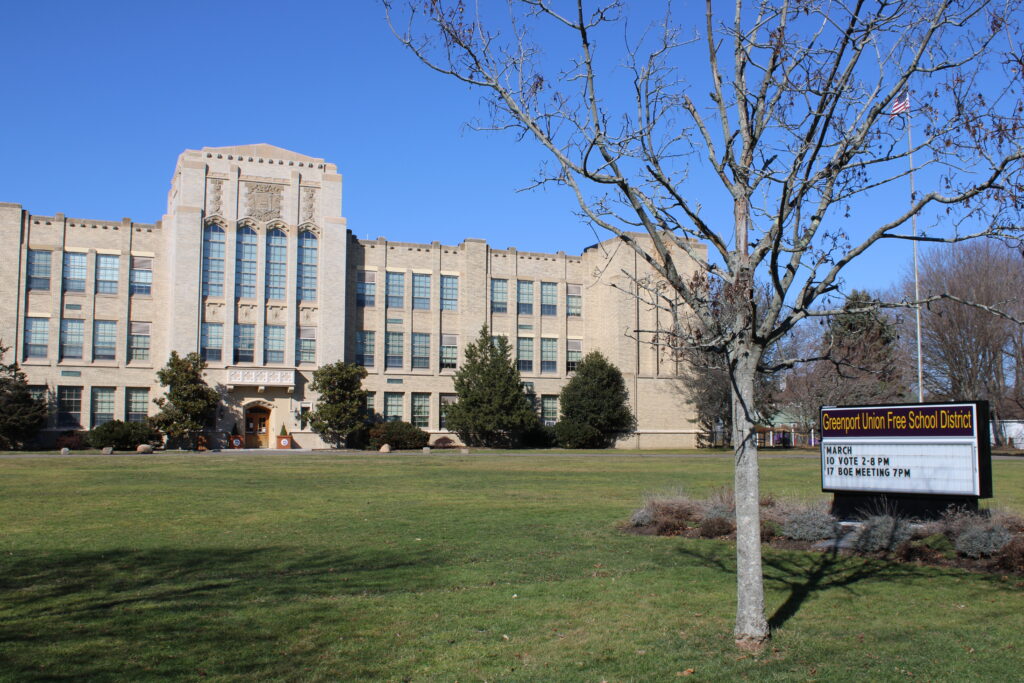
The Greenport School District is facing a $3.1 million budget gap for the 2026-27 school year — driven by rising costs and a sharp drop in projected revenue — officials said at the first public budget presentation March 17.
“When you see a number like this, it can feel overwhelming at first,” said Superintendent of Greenport schools Beth Doyle, who is working through her first budget process since joining the district. “But in budget development, identifying the gap is the first and most important step, because it allows us to address this gap thoughtfully and responsibly.”
Ms. Doyle was joined by Charles Scheid, assistant superintendent for school business, as they briefed the community.
The total expense budget for 2026-27 has a 3.08% increase, from $26.9 million to $27.8 million, while projected revenue drops 8.57% to $24.7 million from $26.9 million.
Ms. Doyle said that a few factors over the last few years have led to the gap, including increased reliance on reserve funds, higher staffing costs and rising debt payments.
First, she said, the district has increasingly relied on appropriated fund balance and reserve funds to balance the annual budget. She said that they are intended to be used “strategically and for specific purposes” and are not designed to support ongoing operating costs year after year.
Second, the district added 20 new staff members during the 2024-25 school year, which significantly increased ongoing expenditures, she said. Those staffing additions are now part of the district’s baseline expenses moving forward.
Debt costs are also rising as the district converts short-term borrowing into long-term bonds tied to a $17.8 million 2019 capital project.
Some of the budget increases include health insurance, some retirement contributions, insurance, transportation contracts and payment of the $17.8 million bond that funded the new gym, lights, auto shop and tech shop. Part of the project was financed through short-term borrowing, or BANs, which the district has been making principal and interest payments on.
Short-term borrowing can only be used for five years, meaning the financing now needs to be converted to long-term bonds, which will be repaid over 15 years. The conversion to long-term financing increases the district’s annual debt service by about $200,000.
When spending grows, while reserves and fund balance are used to close budget gaps, the result is a “structural imbalance” in the budget over time, which Ms. Doyle said is unsustainable.
The state Comptroller’s office designated Greenport as susceptible to fiscal stress.
“We must address this head-on and begin the work of aligning our expenditures with our revenues so that the district is financially stable, not just for next year, but for the years to come,” said Ms. Doyle. “I want to emphasize that while the financial challenge in front of us is significant, we will fix it. Our goal is to develop a budget that is fiscally responsible, transparent to our community and aligned with our mission.”
The presentation shows the allowable tax levy under the state tax cap formula at 3.03%, though the district has not yet announced a proposed levy. That figure will be shared at the next budget presentation on March 31.
The school property tax levy represents the amount a district raises through property taxes to balance its budget. For a homeowner paying about $6,600 a year in school taxes — a typical example used by the district — a 3.03% increase would mean roughly $200 more annually, or about $17 a month.
“Our plan is we’re going to keep going through the budgets, going through the revenue budget, expense budget, and we want to come to a consensus where we have a balanced budget,” Mr. Scheid said. “That’s the goal for March 31.”
The full presentation can be found on the school’s website.