Local waterfowl die-off likely caused by bird flu
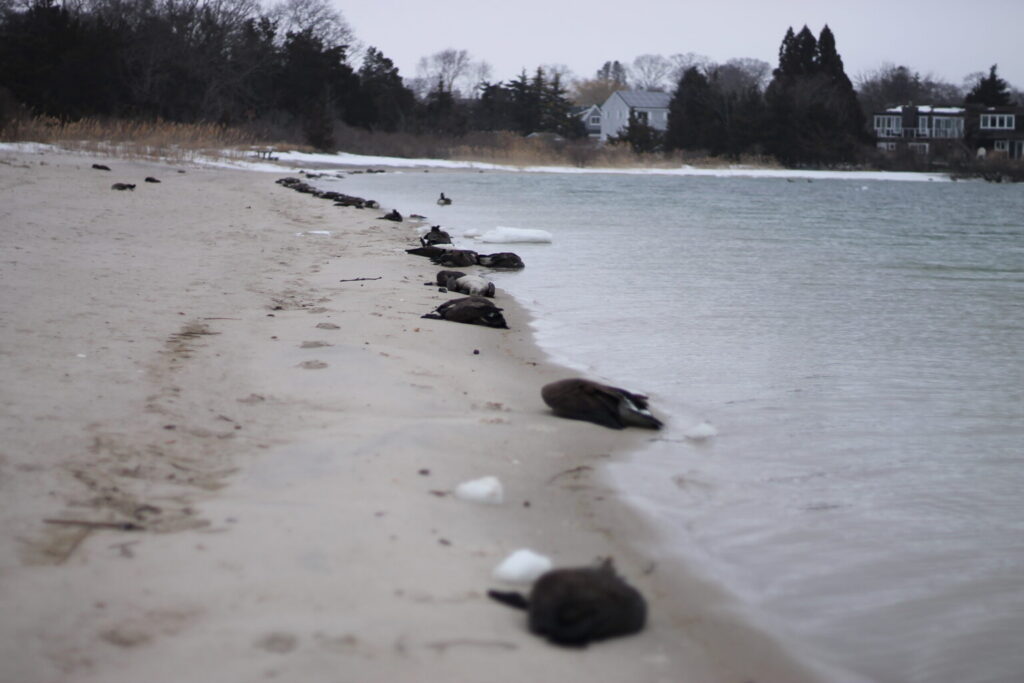
Bird flu has been detected in geese tied to the recent waterfowl die-off in Jamesport, according to preliminary state testing.
At least three Canada geese taken Feb. 16 along Peconic Bay tested “non-negative” for highly pathogenic avian influenza — meaning the preliminary results are considered presumptively positive — a state Department of Environmental Conservation spokesman told the Suffolk Times on Monday.
Six other non-negative test results turned up on the East End over the last three months, the DEC rep added.
For Crescent Duck Farm in Aquebogue — still rebuilding after last year’s outbreak forced it to cull its entire flock — the results revive a familiar fear.
“It certainly increases the level of anxiety,” owner Doug Corwin said Tuesday. “When anybody tells me about bird flu, I keep saying we’re playing Russian roulette.”
Last month, the Suffolk Times confirmed more than 100 dead birds along the Peconic Bay shoreline and in the water. A number of other birds displayed symptoms of HPAI.
The DEC said Sunday that confirmatory testing at the U.S. Department of Agriculture’s National Veterinary Services Laboratory is underway. The agency did not provide a timeline for when results may be available.
The six other non-negative test results included a common crow in Laurel and a red-tailed hawk in Hampton Bays in February; a snowy owl in East Hampton in January; and a snow goose in Southampton, a hooded merganser in Sag Harbor and a red-tailed hawk in Montauk in December, the DEC said.
The NYSDEC provided answers to bird flu questions. (Footage courtesy of the NYSDEC)
This winter’s harsh conditions made food and fresh water sources scarce, causing “a tremendous weakening of the population,” Mr. Corwin said. In turn, it made wild birds more susceptible to the airborne virus.
Last August, Mr. Corwin took a key step forward toward the farm’s recovery when the first full clutch of new eggs went into the incubator. However, this potential bird flu outbreak has forced delays in his plans for two main flocks of breeding stock.
“I had planned to use them right about now, but I’ve delayed my plans about three to four months because I want this viral load that’s in the environment to tame down before I restart everything,” Mr. Corwin said. “I don’t want to restart everything and wind up out of business for good. Instead of being in production in June, it’s probably going to be more like fall because of what’s going on here right now.”
As a precaution, he is keeping the two large flocks extremely isolated. Only one person is allowed into the sealed barn at a time, and they must wear a protective Tyvek suit and follow a disinfectant protocol.
“We do what we do to keep these things safe, and hopefully we get through it, and then we move forward,” the duck farm owner said. “But in the meantime, we’re just going to do every last thing we can to try to keep going.”
Bird flu can spread to humans who are in close proximity to infected animals but does not spread from person to person, meaning the risk to the general public remains low.
There haven’t been any cases of bird flu in humans in New York, according to Kevin Hynes, the DEC Wildlife Health Program Leader. He said the roughly 70 cases nationwide all occurred in people who work in infected dairy and chicken farms.
To help with monitoring HPAI in waterfowl, the NYSDEC built a reporting tool to be used when multiple dead birds — either the same species or different ones in the same area — are found.
Beyond reporting mortalities, according to the NYDEC, the public can help minimize risk and limit disease spread by preventing contact between domestic animals and wild birds. They also said to assume groups of birds found deceased are HPAI-positive and to avoid them.
Should removal be necessary, NYSDEC advises use of disposable gloves, a mask and eye protection. Avoid direct contact with the carcass by using a shovel and wash hands and clothing immediately afterward with soap and hot water. Carcasses should be triple bagged and placed in an outdoor trash can.
For more information on keeping other species safe from HPAI, such as song birds and home poultry flocks, see turtlebackconservationcenter.com.