Greenport schools propose budget that doubles tax cap, cuts 21 positions

The Greenport School District proposed a $26 million budget that cuts nearly two dozen positions and more than doubles the state tax cap as officials try to rein in years of reserve spending.
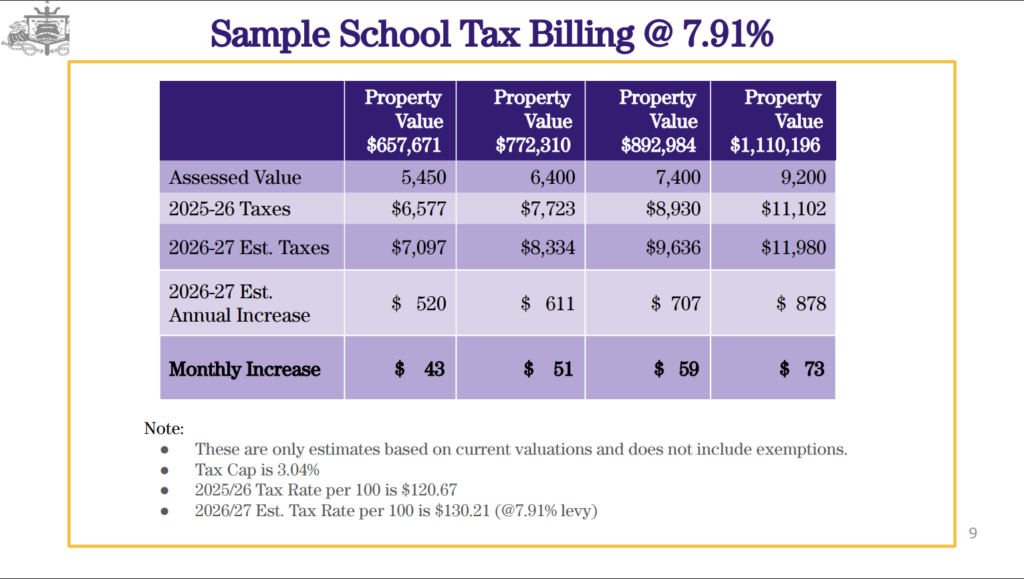
The $25,995,000 spending plan for the 2026-27 school year, presented Tuesday, March 31, includes a 7.91% tax levy increase, far above the district’s 3.04% cap. For homeowners, that would mean about $43 more per month.
The proposal comes as district officials move away from a pattern of using one-time reserve funds to pay for ongoing expenses — including the addition of 20 positions in the 2024-25 school year.
That approach helped drive down the district’s fund balance, which is now projected to be depleted. Over the past several years, the district has leaned heavily on reserves to close budget gaps, according to Superintendent Beth Doyle, who is presenting her first budget.
The proposal comes just weeks after voters overwhelmingly approved a $1.97 million capital project for athletic facilities — a point of confusion for some residents. District officials stressed that those funds are legally restricted and cannot be used to offset operating costs.
“These reductions are necessary to bring the budget into a sustainable position while preserving as much of our core programs as possible,” Ms. Doyle said during the presentation. “These decisions were made through a careful review of our staffing structure and program priorities. These are extremely difficult decisions, but they are necessary to put this district on stable footing moving forward.”
Ms. Doyle’s proposal calls for the elimination of 21 positions district-wide, including one administrative role, 10 instructional positions and 10 non-instructional positions. No final decisions have been made, and the district is continuing to review staffing options with the Board of Education, she stressed.
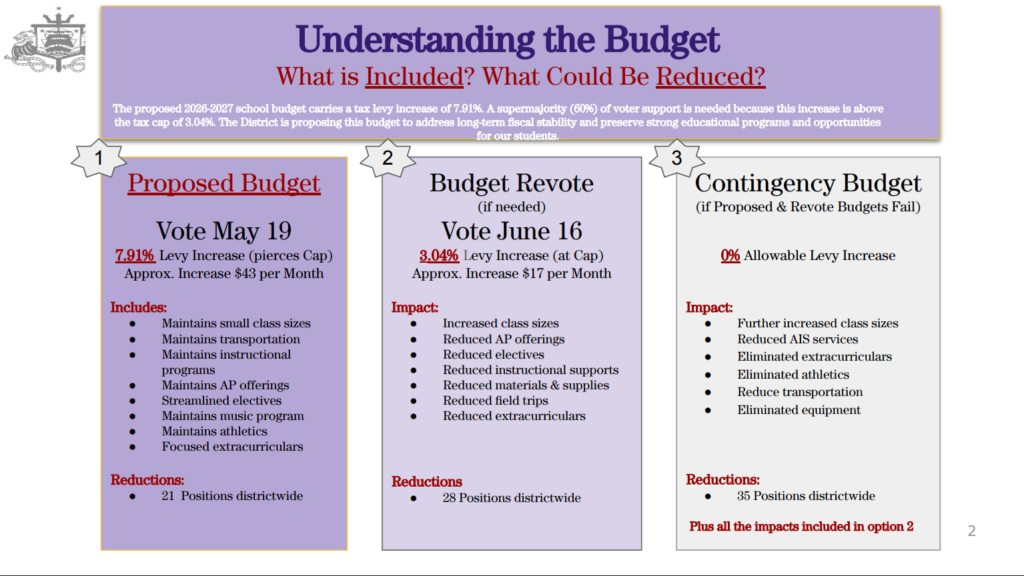
Despite the proposed cuts, officials said the budget maintains small class sizes, transportation, instructional programs, Advanced Placement offerings, music, athletics and extracurricular activities.
Those programs, however, hinge on voter approval of the 7.91% increase — and could face nearly three dozen cuts if voters reject the plan.
Because the proposed tax levy exceeds the cap, it will require approval from at least 60% of voters on May 19.
“You’re looking at 7.91%. It’s a significant increase,” said Charles Scheid, the assistant superintendent for school business. “We’ll do our best. That’s the number we’ve worked at, there’s a lot of different back and forth.”
If the vote fails, deeper cuts follow; the district’s fallback plan — within the 3.04% tax cap — would increase class sizes, cut electives and field trips, and eliminate 28 positions.
A revote would be held June 16 if that proposal is rejected.
If voters again shoot down the tax hike, a contingency budget would carry no levy increase and eliminate 35 positions, along with deeper cuts to programs and services.
Even if voters approve the increase, overall spending in the proposed budget is down about 3.6% from the current year — a reflection of the district’s effort to reduce costs after years of relying on reserves.
Enrollment in Greenport has remained relatively stable over the past decade, unlike neighboring districts that have seen sharp declines, as The Suffolk Times previously reported.
Ms. Doyle acknowledged the difficulty of the proposal but said the goal is to avoid deeper cuts in the future.
“What I want the community to know is that these are difficult but necessary decisions,” said Ms. Doyle. “Our goal is to preserve as many student programs and opportunities as possible while putting the district on stable financial footing for the future. That requires making thoughtful, sometimes hard choices now to avoid deeper cuts later.”
Some community members said they understand the district’s position, even if the increase will be a hard sell.
“This is going to be tough. This is not easy,” said Sonja Derr, a district parent and PTO member. “It’s going to be very tough to convince people of a 7.91% increase, even though when I look through the list, it’s absolutely necessary. It’s a very tough place for them to be in, but at the same time, I really have a lot of trust in who we have.”
District officials emphasized that the capital project funds are separate from the operating budget.
“Those funds are legally restricted and can only be used for facilities and infrastructure projects, not for salaries or day-to-day operating expenses,” Ms. Doyle said. “The financial challenges we are addressing in this budget are tied to recurring costs and prior spending patterns, which require long-term structural adjustments. They are completely separate financial matters.”